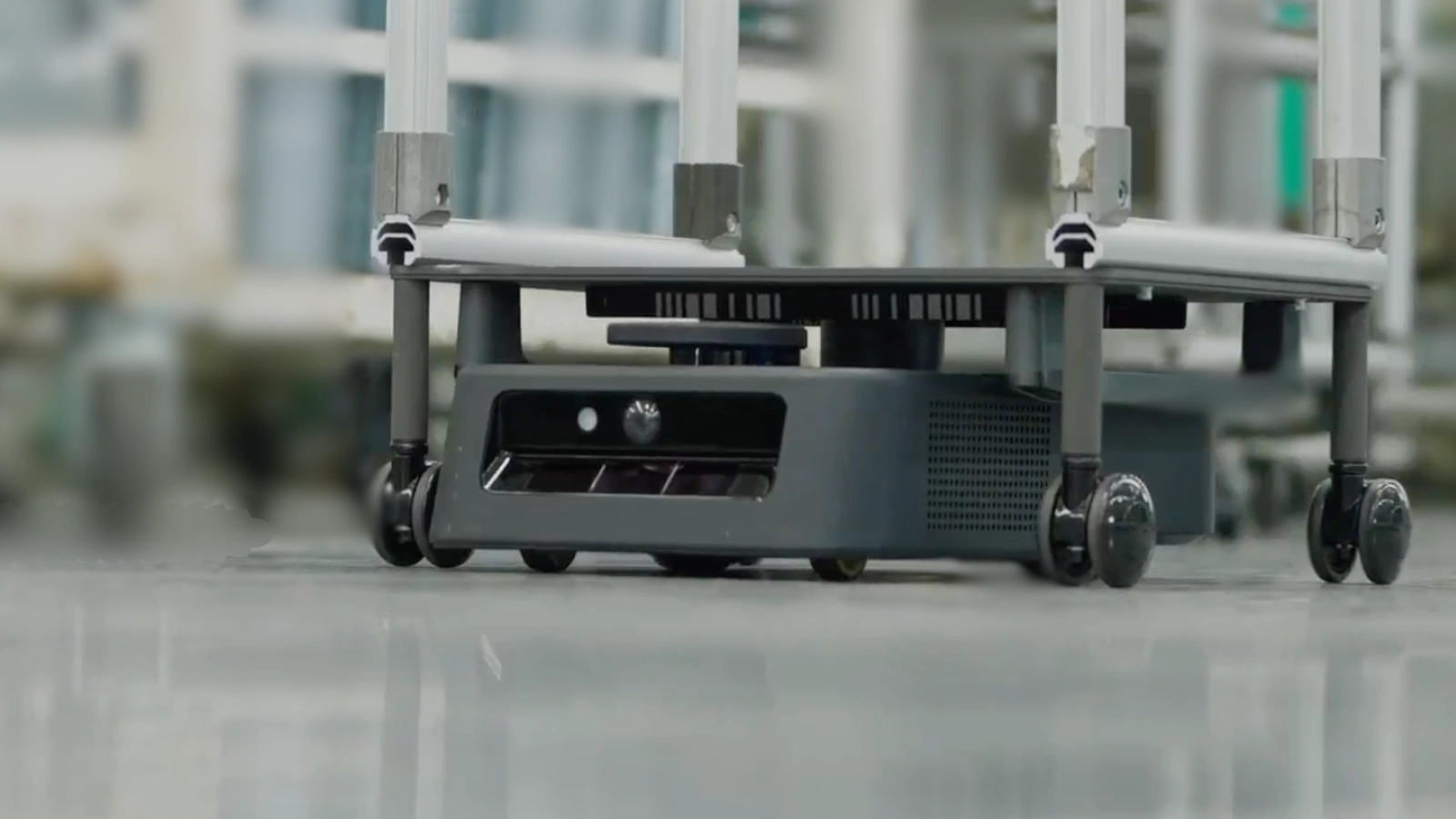
Geekplus Japan has begun offering Preferred Robotics’ Kachaka Pro and Kachaka Evo transport robots through ziict, its initiative for combining automation products around customer needs. Both companies announced the arrangement on September 24. Geekplus describes these as the initiative’s first partner products. The change gives the Japanese supplier another route to customers seeking smaller machines for factories and warehouses.[1,2]
The companies say the addition addresses narrow passages and small, light loads that larger transport robots do not readily serve. Preferred describes Pro as a machine that moves dedicated shelving, while Evo lifts compatible carts and racks and has a stated maximum carrying capacity of 100 kilograms. These are supplier descriptions, rather than independently measured performance in a new customer installation.[1,2]
The product documentation makes the compactness claim more specific. Kachaka Pro’s minimum passage width is 550 millimeters when pulling the Kachaka Base, but 650 millimeters with the Kachaka Shelf. Its 30-kilogram transport allowance on hard floors includes the dedicated shelf itself; the specification lists 20 kilograms on carpet. A buyer therefore cannot treat either the smallest aisle figure or the largest load figure as applying to every configuration.[3]
That distinction changes the purchasing question. A factory evaluating a narrow route needs to measure the complete carrier and load, then compare them with the actual passage and floor surface. Subtracting the shelf’s weight from the allowance also matters before choosing how much material to move per trip. The channel expansion broadens access, but does not remove those site-specific constraints.[1,2,3]
There is already a product and support framework behind the announcement: Preferred’s documentation describes app-based setup, an interface for external software and a fleet manager for multiple robots. That is useful counterweight to treating this as a concept reveal. However, the two announcements and LNEWS’s September 24 coverage do not identify a new joint customer installation or supply measured operating results from this distribution arrangement.[1,2,3,4]
The next useful evidence would be a named installation through the new channel, with its shelf configuration, usable load, route width and completed trips between human interventions. Those details would show whether the expanded catalogue converts into reliable movement at a customer site. For now, the verified development is a commercial distribution relationship; the practical finding is that route fit depends on the configuration being purchased.[1,2,3]