What happened
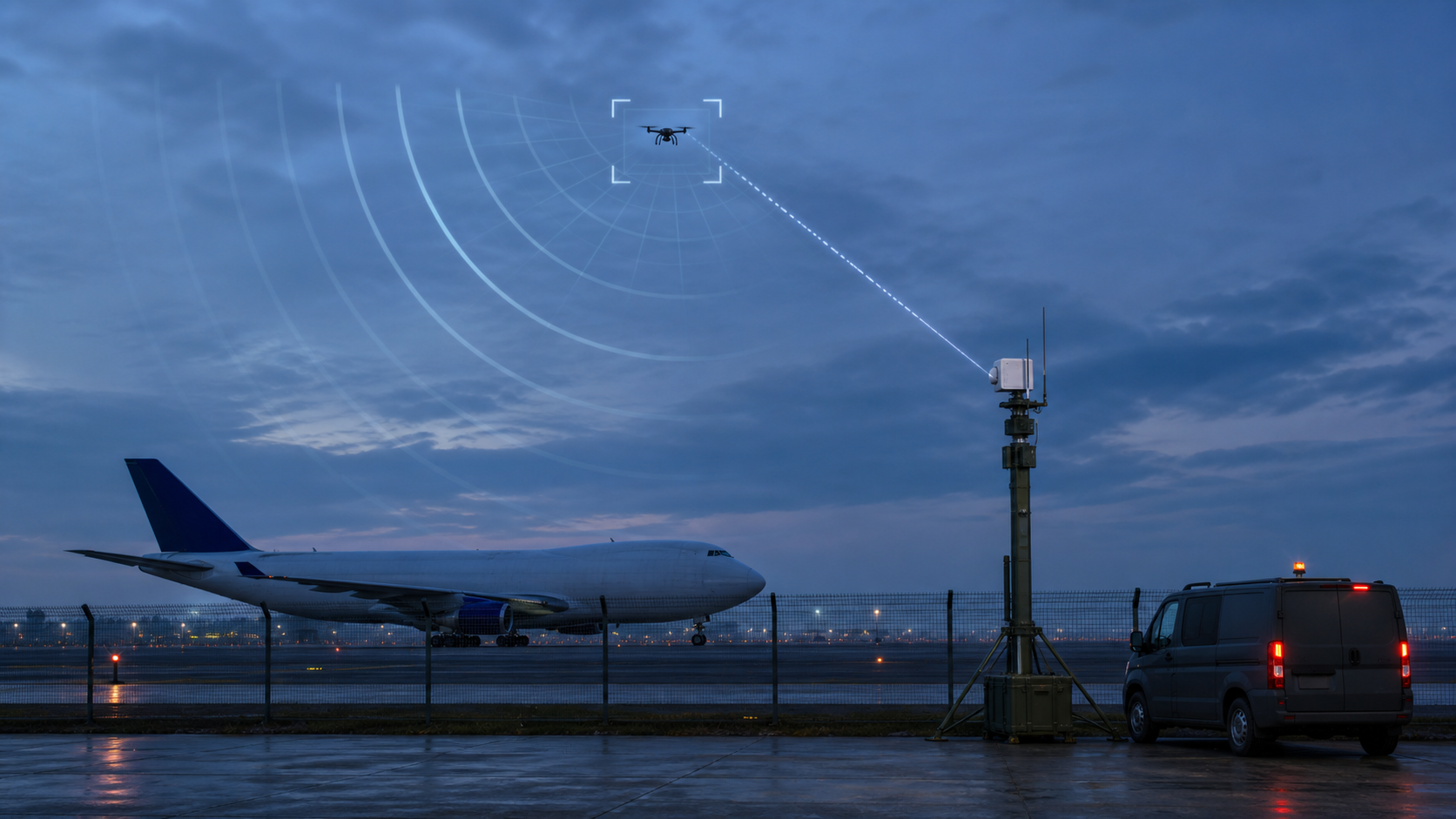
The new detail in Germany’s Leipzig/Halle airport case is not simply that a drone carrying an explosive device was found. Le Monde reported on August 11 that investigators’ review of airport surveillance cameras showed the quadcopter striking a Ukrainian Antonov cargo aircraft on August 4, leaving impact marks around the wing and fuselage before the charge detached. The explosive did not detonate, but the public record still does not explain why. Le Monde also reported that investigators collected DNA and that a federal-police detection system was deployed on the airport roof after the incident. Those details make the case a systems question: detection, classification, safe response, aircraft coordination, forensic preservation, and authority all had to work across one live freight environment.[1]
The Associated Press had already established the underlying incident and its institutional escalation. Its August 6 report said an airport employee found the drone near the south runway, that the device was defused, and that a separate unknown object hit a freight aircraft after a landing was aborted. Federal prosecutors then took over the case, describing it as a serious attack on transportation and logistics infrastructure capable of undermining Germany’s internal and external security. The same report said Germany has airport drone-defense technology but that officials and experts described a practical limit: a system may track an aircraft without being able to safely bring it down near other aircraft, people, or protected infrastructure.[2]
The operating gap
Germany’s legal baseline has moved faster than its demonstrated operating coverage. The Bundestag’s February 26 record says the amended Aviation Security Act allows the armed forces to assist states and police with drone defense, including shooting down a drone as a last resort when that is the only way to prevent a particularly serious accident. The same parliamentary record says authorities may not be able to protect critical infrastructure everywhere because the required reaction times are extremely short, and it calls for examining the responsibility of infrastructure operators. In other words, the law recognizes a response problem without proving that the response chain works at every airport.[3]
The measured operational delta is therefore more important than the political promise of stronger defenses. Le Monde reported 166 drone incursions at Germany’s 15 main airports in the first half of 2026, compared with 101 across the whole of 2025. It also reported that the transport minister said only Munich and Frankfurt were truly equipped to respond to such flyovers, while Germany’s air-security responsibilities remain split among 19 administrations. The comparison does not establish that every incursion was dangerous or that the Leipzig device bypassed a specific sensor. It does show why an airport safety case cannot stop at radar coverage or a new legal power: it must document who can confirm the object, who can authorize action, what effect is safe near aircraft, and how the decision is audited afterward.[1,3]
That chain exposes more than the airport. Cargo operators and airlines carry the immediate disruption and collision risk; airport workers and passengers carry the human exposure; police and military units carry the authority and escalation burden; and logistics networks carry the cost of a runway closure or a compromised hub. The safety requirement also travels to other critical sites where counter-drone action can create a second hazard, including ports, energy facilities, warehouses, and defense supply nodes. A response system that detects an aircraft but cannot act within the relevant time window may still be useful for evidence and warning, but it is not the same as a complete protective control.[1,2,3]
What remains unproven
The public record does not establish who operated the drone, whether it was state-directed, how it entered the airport environment, or why the charge failed. German officials described a hybrid attack scenario but did not publicly assign responsibility in the sources opened for this analysis. The forensic claims in the August 11 follow-up are reported through Le Monde’s account of investigators and Die Zeit, not through a public incident report opened here. That limits the article to the demonstrated control problem and prevents a stronger attribution or failure-cause conclusion.[1,2]
The next useful checkpoint is not another count of sightings. It is a public forensic or prosecutorial finding that fixes the event timeline and mechanism, paired with an operator-level test of detection-to-intervention coverage at major airports. That record should show the sensor conditions, the handoff between authorities, the safe operating envelope for any interdiction, and the return-to-service decision after an incident. Until then, Germany has expanded counter-drone authority and added equipment at Leipzig, but the evidence still describes a fragmented response architecture rather than a verified airport-wide safety case.[1,2,3]