The data is genuinely public
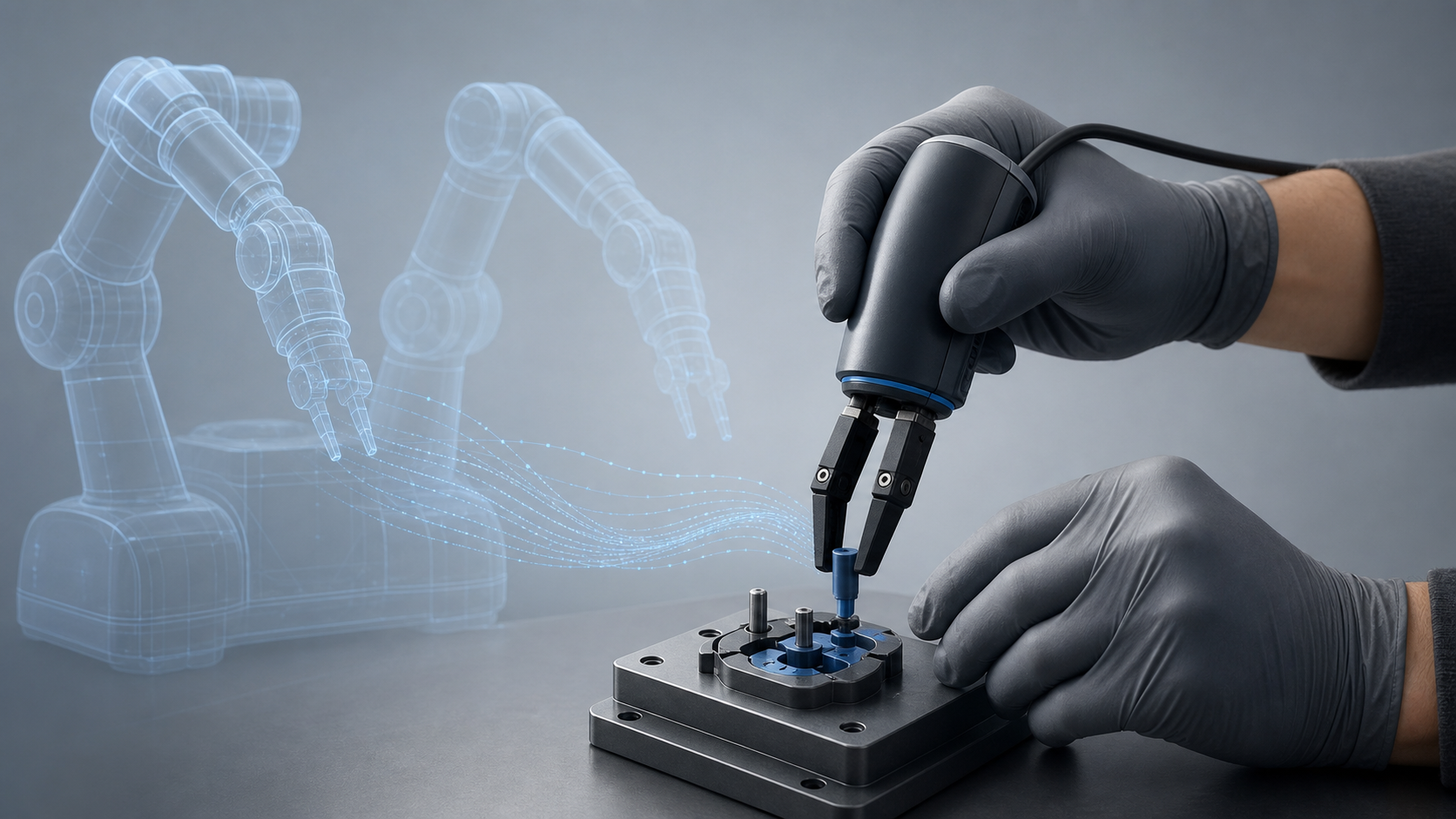
Simple AI's HiFi-UMI paper, submitted on July 28, is paired with a public 2,000-hour manipulation dataset under a Creative Commons Attribution 4.0 license. The release includes six synchronized camera views, calibrated hand trajectories, gripper states and task metadata across more than 480 scenes. The paper's material claim is that post-training on those robot-free demonstrations can transfer directly to a real bimanual robot: across three policy backbones, its strongest reported precision-insertion result is 85%. Those are the authors' experimental results, not an outside replication.[1,2]
That claim targets a real bottleneck. The original Universal Manipulation Interface showed that a handheld gripper could turn human demonstrations into deployable policies, publishing code, hardware guidance and tutorials alongside its 2024 Robotics: Science and Systems paper. HiFi-UMI argues that more precise pose, wider visual coverage and tighter synchronization can remove the real-robot teleoperation anchor used in post-training. If that generalizes, the cost and availability of data—not only robot time—would become the design constraint.[1,3]
Data access is not policy access
Data access is not policy access. HiFi-UMI-2K is a curated 2,000-hour subset of a source corpus reported as more than 20,000 hours and 4.32 million episodes. Its documentation cautions that stored next-state targets may be converted to model-specific relative actions during training. During this review, the accessible Simple World Lab profile listed zero public models, while the data card exposed the data layout but no policy weights or training repository. That does not contradict the paper; it means the headline result cannot yet be independently rerun from the public release alone.[2]
The next checkpoint is concrete. UMI-Bench frames the missing work as reproducible real-robot evaluation: data collection, scene reset, execution, logging and task-factor analysis must travel together to test generalization beyond curated demonstrations. HiFi-UMI's public data is therefore worth inspecting now, but it is not yet evidence that a buyer or integrator can remove teleoperation from a production workflow. Public policy artifacts followed by an independent UMI-Bench-style result would change that conclusion. Until then, the story is an open data asset paired with a promising but author-reported deployment result.[1,2,4]