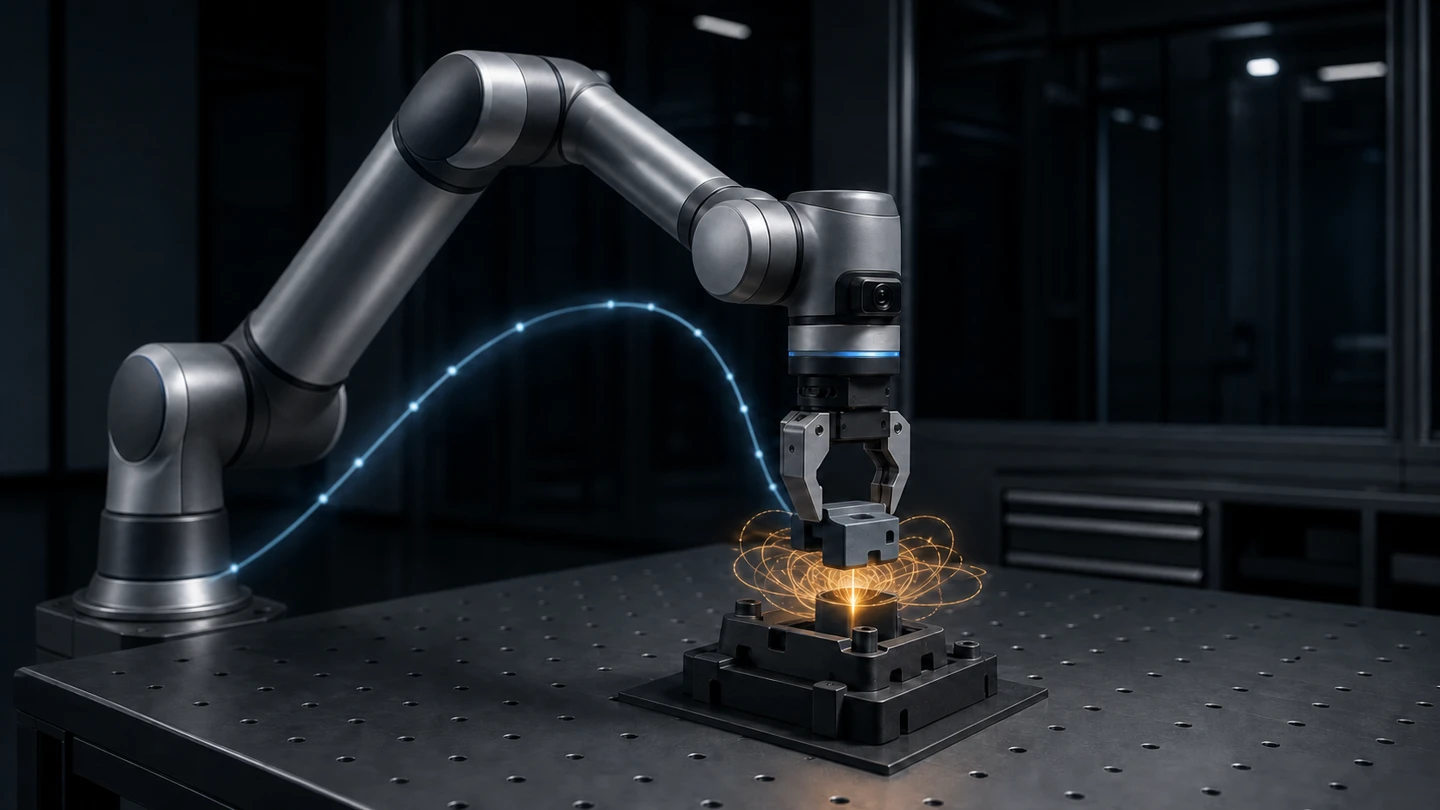
The gain is at the insertion
The paper, an unreviewed preprint, entered arXiv’s Monday robotics listing after a July 17 submission. A Technical University of Munich and Siemens team reports a robot-learning system that does not try to learn an entire manipulation task. It plans ordinary motion through free space, then hands only the contact-rich segment to a learned policy. Across shelf stocking, Lego stacking and two fan-cover assembly tasks, the system’s full-success rates were 98%, 94%, 96% and 94%. Each policy ran 50 trials, so the percentages resolve to 191 complete tasks in 200 attempts. The strongest comparator tested on all four tasks, pose estimation plus motion planning, completed 110 of 200. These are the authors’ results, not an independent replication.[1,5]
The full-versus-partial split explains where the method helps. The planning baseline averaged 97% partial success but only 55% full success. In the paper, partial means the part reached the correct place without being fully inserted, stacked or assembled. The new pipeline averaged 99% partial success and 96% full success. Its advantage is therefore not evidence of broader task understanding; it is evidence that focused contact learning converted coarse placements into finished insertions. The fan-cover task was derived from a production line that currently uses manual assembly, although the reported test remained a laboratory analogue.[1]
One demonstration, then dense local data
The data pipeline starts with one kinesthetic demonstration and a fixed scene. The robot replays that trajectory to the uncertain contact region, then mixes goal-directed and random actions inside a safety boundary. Successful and failed rollouts train an offline reinforcement-learning policy with a sparse task reward. At deployment, language-guided segmentation and FoundationPose estimate the parts, waypoints handle transport, force-torque feedback triggers the learned insertion policy, and the learned value function decides when that segment has succeeded. The authors report roughly 2 to 2.5 hours of autonomous collection for each learned task, with a few unquantified human interventions when the scene was not reset correctly.[1]
The same structure carried into the authors’ out-of-distribution tests. With distractors, changed backgrounds and altered part positions, the method completed 72 of 80 trials across the four tasks. The difficult fan-cover evaluation reused the simpler fan-cover policy without additional data and completed 19 of 20 trials. The paper also reports that its peak applied forces were 49% lower on average than the baselines, attributing that difference to segment-specific force control and a planned final push. The force claim is supported by the paper’s plots, but not by released raw measurements or an outside rerun.[1]
The comparison has a hard boundary
The quantitative setup removes several problems that a production station would need to solve. Base objects stayed fixed, and the fan base was assumed fixed rather than estimated. The inserted object changed position, but every learned policy in the measured trials produced actions in four Cartesian dimensions: three translations and one rotation. Full six-dimensional manipulation appeared only in additional qualitative demonstrations. The collection scene also remained unchanged and could use printed fixtures. Close distractors inside the cropped wrist image, shifted shelf objects, parts sticking to the gripper, reflective surfaces, exotic shapes and occlusion all appear as limits or failures in the paper.[1]
Hardware precision is part of the result. The authors say their method benefits from a robot that reaches waypoints accurately and used a Franka Research 3 with a wrist force-torque sensor and depth camera. Franka’s datasheet specifies pose repeatability below plus or minus 0.1 millimetres and a one-kilohertz Franka Control Interface for that platform. A less precise arm, flexible fixture or moving base could challenge the bounded contact region used here. The paper does not establish that the same data efficiency survives those changes.[1,3]
The baseline comparison also needs care. HIL-SERL, a prior human-in-the-loop reinforcement-learning system, was evaluated only on shelf stocking and Lego stacking here and recorded 10% and 6% full success. The TUM and Siemens authors say reproducing its performance was difficult and simplified the shelf task by starting with the package already grasped. The original HIL-SERL work reports near-perfect performance on different manipulation tasks with 100-trial evaluations. The defensible conclusion is that the modular pipeline beat the tested implementations on these four setups, not that it has displaced every end-to-end or human-guided method.[1,4]
Reproduction is the next test
The paper says all videos, training datasets and evaluation datasets will be uploaded. At the July 20 inspection, the public project repository contained the static project page, paper and videos but no implementation, training data, evaluation data or repository license. That matters because the system is more than one policy: it combines segmentation, pose estimation, waypoint definitions, a safety filter, force thresholds, a learned success threshold and task-specific controllers. Without the artifacts, another lab cannot yet audit the training distribution or rerun the reported comparison from the public package.[1,2]
For operators, the useful hypothesis is narrow and testable: stable workcells with a clearly identifiable insertion phase may need dense robot data only around contact, not across the whole task. The next evidence should move the fixtures, use all six Cartesian action dimensions, vary reflective and occluded parts, publish intervention counts and cycle times, and report repeated force distributions on hardware outside the authors’ lab. If completion remains near 96% under those conditions, targeted collection would be a practical alternative to scaling end-to-end demonstrations. If pose, cropping or precision failures dominate, the current result will remain a strong workcell-specific method rather than a general assembly solution.[1,2,3]