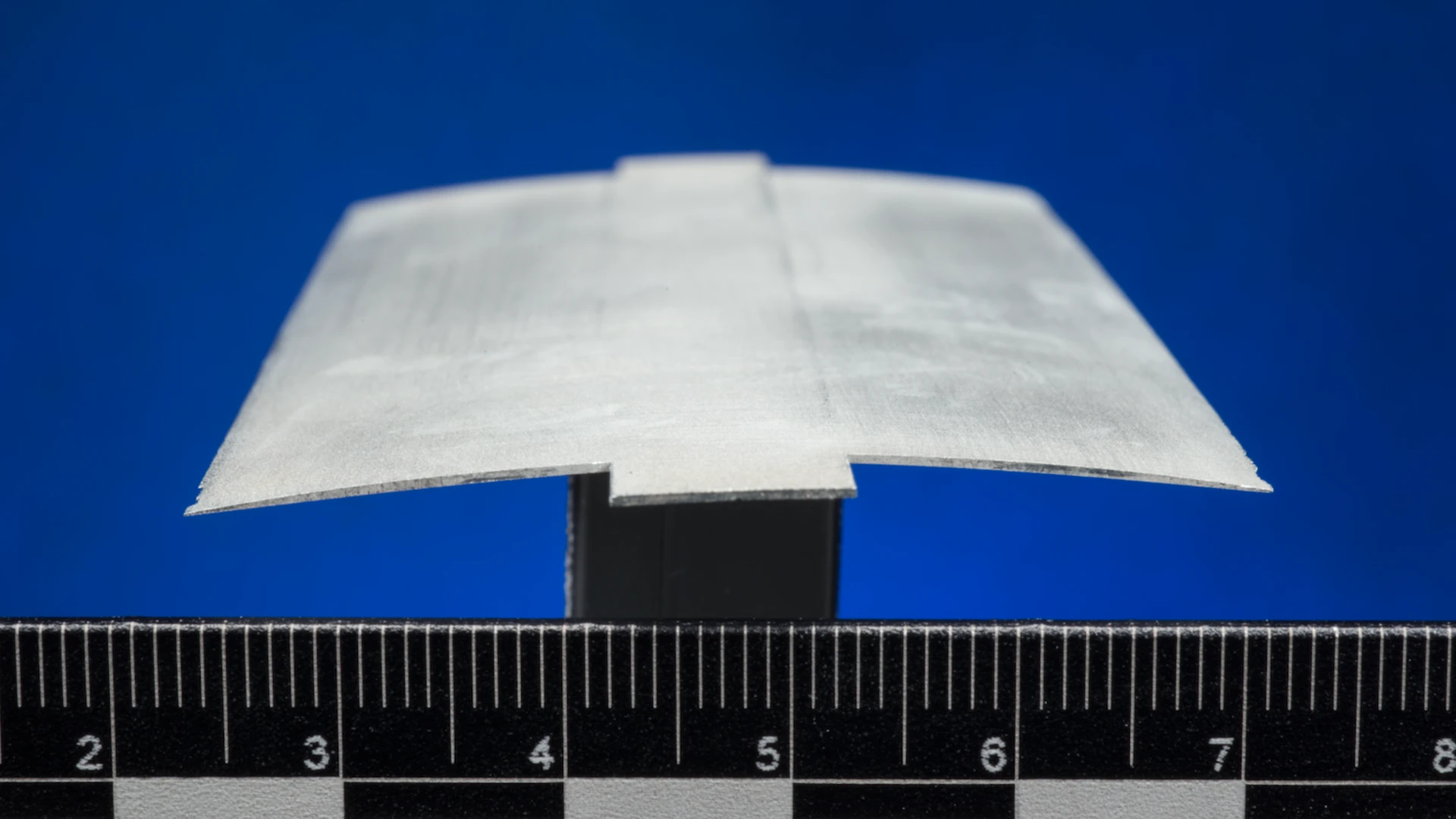
A new Mars helicopter blade shape has evidence of better aerodynamics, but the headline distance gain is still a projection. NASA’s October 20 update describes roamx-0201, a thin experimental airfoil intended for future rotorcraft. The useful distinction is between testing the shape of a blade and proving the range of a complete flying robot.[1,2]
The study record compares it with CLF5605, the airfoil flown on Ingenuity, at Reynolds number 20,000 and Mach 0.60. Those specify the balance of inertial and viscous effects and the flow speed relative to sound. Two computational methods and physical testing in Tohoku University’s Mars Wind Tunnel found roughly 19–43% better lift relative to drag across their methods.[2,3]
That is a component-efficiency result under defined conditions, not a 19–43% measured increase in flight distance. The record also attributes approximately 20% higher maximum lift to the two computational methods. Keeping those labels matters: the simulations and tunnel tests form different parts of the evidence rather than interchangeable flight trials.[2]
The aircraft still has to earn the range
NASA describes simulations suggesting that redesigned blades could extend a single flight from Ingenuity’s 0.7 kilometres to as much as 18.7 kilometres while carrying scientific instruments. It also says the technology is not yet ready for Mars and that researchers are resolving differences between computational predictions and physical performance. The distance comparison is therefore a design opportunity, not a demonstrated mission capability.[1]
The mechanism is more specific than simply spinning faster. The thinner shape deliberately changes airflow near its leading edge and delays the sharp increase in drag associated with approaching the speed of sound. Imperial’s account places the experiments in Mars-like, low-density conditions. Imperial and NASA are collaborators in the same study; their accounts do not establish an independent replication.[1,3]
For future aerial exploration, the next useful evidence is a rotor or aircraft test that connects this aerodynamic improvement to usable range, payload and stable operation under stated conditions. Until that bridge is measured, planners can treat roamx-0201 as a stronger component candidate without budgeting a Mars mission around an 18.7-kilometre flight.[1,2,3]