Continuity was the clean win
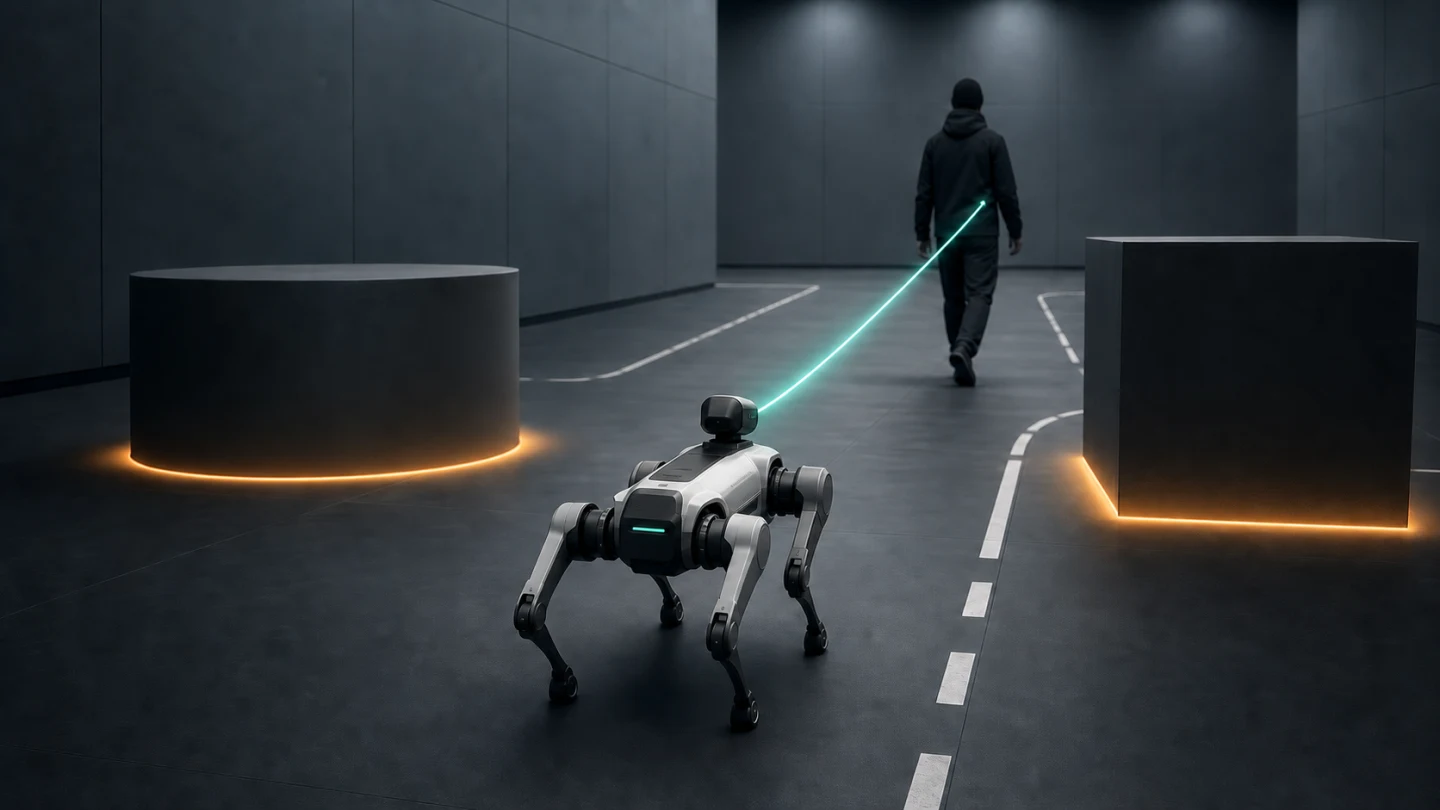
OpenBMB has released the code and weights for MiniCPM-RobotTrack, a compact vision-language-action system for a quadruped following a designated person. The public repository—whose first commit landed at 19:18 UTC on July 18, while OpenBMB's release entry is dated July 19 in China—also includes three EVT-Bench evaluation files with 1,405 episodes apiece, or 4,215 in total. OpenBMB's README labels them static, dynamic and adversarial tracking; the benchmark paper names the same STT, DT and AT families Single-Target Tracking, Distracted Tracking and Ambiguity Tracking. That distinction matters because the harder tests introduce distractors and look-alike targets rather than merely changing motion.[1,2,3]
Against the current open OmTrackVLA result, MiniCPM's author-reported tracking rate is higher in every test: 89.8% versus 82.77% for STT, 73.4% versus 58.80% for DT and 80.4% versus 73.89% for AT. STT is the unambiguous row: MiniCPM also reports higher episode success and fewer collisions. The harder rows split. In DT, MiniCPM reports 53.2% success versus 41.54%, but 13.6% collisions versus 11.31%. In AT, its 58.0% success trails 60.04%, and its 9.0% collision rate exceeds 7.60%, even though it tracks the target for more steps.[1,4]
Three metrics answer different questions
The benchmark's appendix explains how continuity and a safe ending can diverge. Tracking rate is the proportion of time steps in which the target is successfully tracked. Success rate asks whether the episode ends with the robot oriented toward the target at a safe distance of one to three meters. Collision rate counts episodes terminated by contact with the target humanoid. A policy can therefore keep the correct person in view for more of a run while still approaching poorly, ending outside the target zone or making contact. MiniCPM's table supports a tracking-continuity claim, not a blanket safety claim.[1,3,4]
OpenBMB attributes the result to compressed visual features, temporal context and closed-loop data aggregation that adds policy-generated failures back into training. The system uses DINOv3 and SigLIP vision encoders around a roughly 0.5-billion-parameter backbone. The released checkpoint itself contains about 449.8 million parameters, while the repository describes the complete system as 0.9 billion. External encoders likely explain part of that gap, but OpenBMB does not provide a component-by-component parameter reconciliation. The release also says a Unitree Go2 EDU runs the model onboard at more than five frames per second, around 180 milliseconds per action.[1,2]
Open enough to test, not yet independently rerun
This is a more testable release than a video or scorecard alone. The repository exposes training and evaluation code, benchmark inputs, weights and a Go2 deployment path whose default mode does not send commands to the robot. OpenBMB licenses its repository code and model weights under Apache 2.0, while required third-party models, simulator code, datasets and assets retain their own terms. But the repository currently consists of one commit with no tag or formal release, and its logs directory contains only a placeholder. The 4,215 inputs verify the test-set cardinality; they do not independently verify MiniCPM's outcome scores. The public package contains no per-episode result outputs from the reported run, so the aggregate table remains an author-run result.[1,2,3]
The decision change is narrow but useful: MiniCPM-RobotTrack reports higher continuity than the one open-weight baseline in the checked comparison, while its own table warns against treating target retention as safe following. The next evidence should be an independent run across all three released splits with per-episode outputs, followed by repeated Go2 trials reporting attempts, completion, collisions, human interventions, power draw and latency distribution. A tagged release and those two tests would move the claim from inspectable author evidence toward a reproducible edge-robot capability.[1,2,3,4]