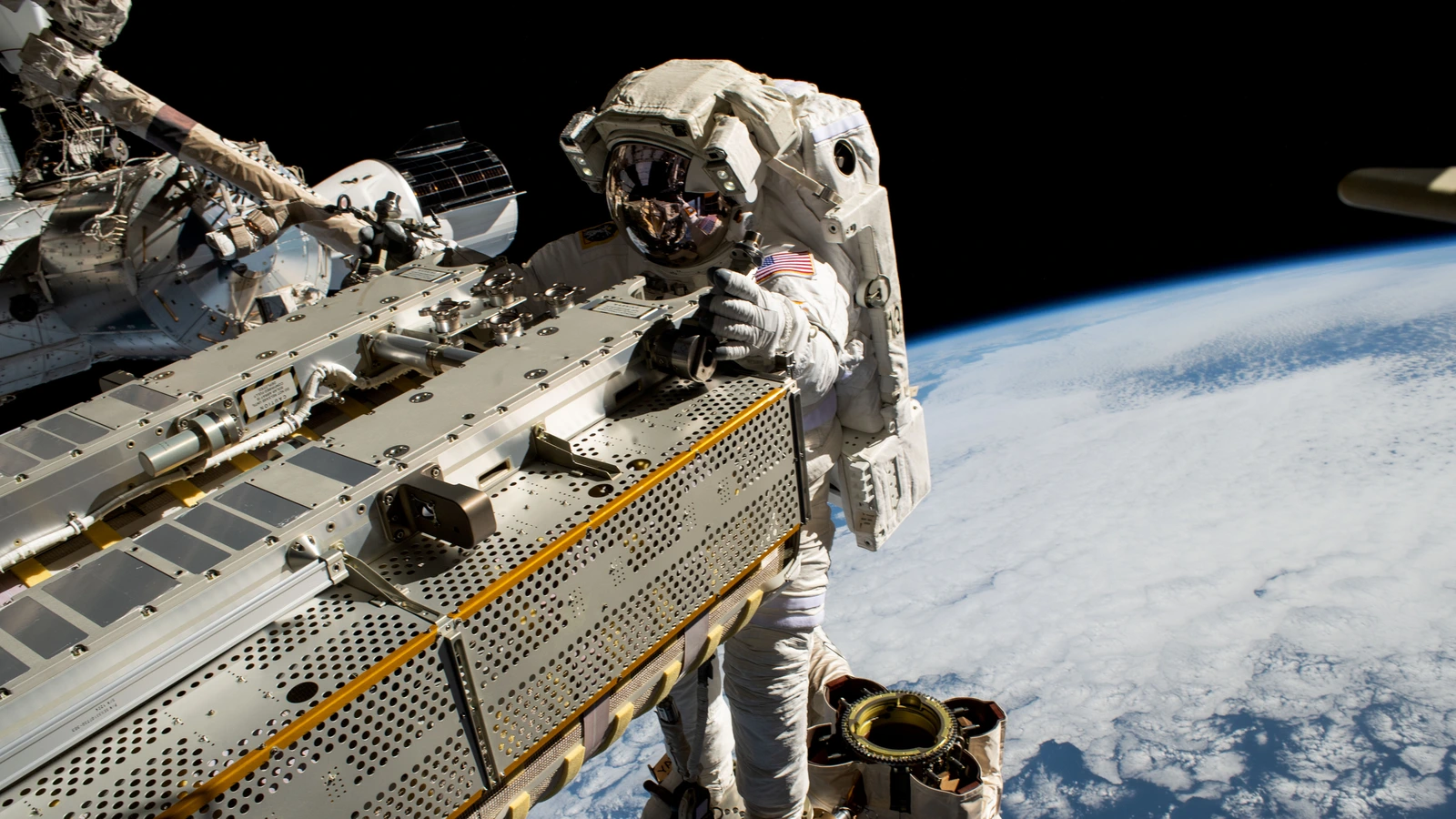
NASA’s November 2 station update puts robotic-arm procedure review on the critical path to the International Space Station’s final roll-out solar-array installation. Four astronauts studied the Canadarm2 procedures and held readiness discussions with mission controllers and robotics engineers before a spacewalk planned for November 5. The preparation follows the completed installation of the seventh array on October 29.[1,2]
The Canadian Space Agency’s separate account identifies the robot’s practical contribution to that earlier job. Canadarm2 provided a work platform for NASA astronaut Anil Menon. Luke Delaney operated the arm from inside the station with support from Jessica Watkins, while Menon and Canadian astronaut Joshua Kutryk carried out the external installation. Canada reports that the spacewalk lasted seven hours and eleven minutes.[2,3]
NASA says the October 29 team installed and deployed the seventh International Space Station Roll-Out Solar Array on power channel 2A. Its next planned installation is the eighth and final array, on channel 3B. The November 2 update places that next job on the station’s starboard truss, opposite the port-side work completed in October. The final installation remains a scheduled task, rather than an accomplished upgrade.[1,2]
The division of labour matters. In this operation the robot positioned a human worker; astronauts outside performed installation tasks, astronauts inside operated the arm, and ground specialists supported the procedure. That is a concrete example of robotics extending maintenance reach within an organised human workflow. It does not establish autonomous assembly or show that the arm eliminated the need for spacewalking labour.[1,3]
NASA describes the full eight-array campaign as increasing available station power by up to 30 percent. That is the agency’s projected campaign outcome, not a measured gain attributable to Canadarm2 alone. Neither the completed-spacewalk account nor the November 2 preparation update provides a controlled comparison of work time with and without the arm. Those records support its role in the job, rather than an estimate of labour savings.[1,2,3]
The next observable checkpoint is the November 5 installation and deployment report. Operators can then distinguish procedural readiness, completed mechanical work and the resulting power-system outcome. The broader lesson is already visible: a mature robotic work platform delivers value through a defined place in a maintenance sequence, with explicit crew and ground-control responsibilities. The mission record, rather than the announcement of a capability, shows how it is used.[1,2,3]