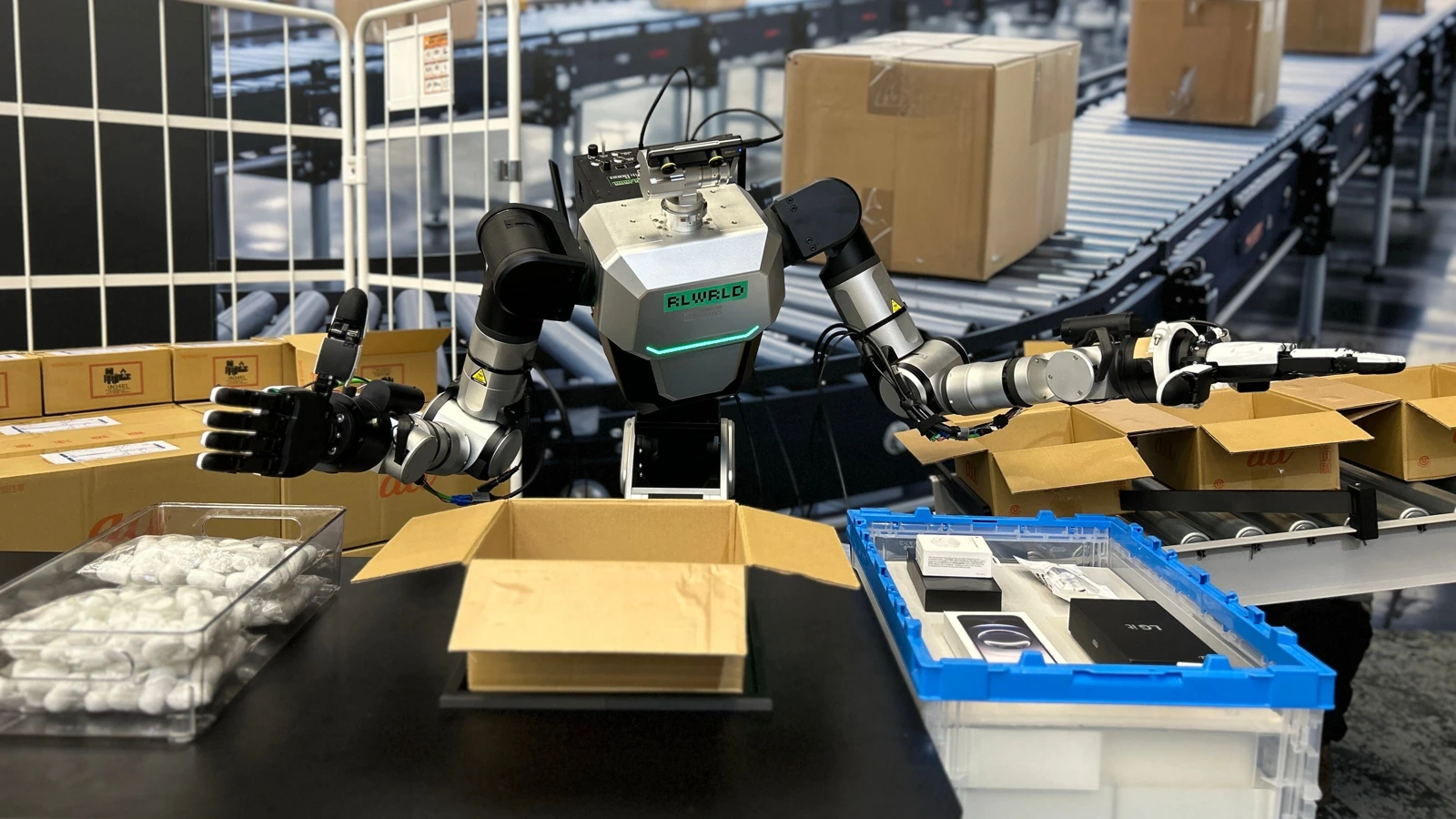
RLWRLD’s October 30 account of a packing demonstration at KDDI Summit describes a useful step beyond an isolated grasp: a five-finger robot handling a sequence of shipping tasks. The event took place in Tokyo on October 27–28. The company says its RLDX-1 model drove a robot that retrieved cartons from a conveyor and packed small items, including smartphone accessories with different shapes and materials.[1,2]
The engineering question is whether the sequence survives disruption. Picking an item, placing it in a box and continuing a job depend on different capabilities. A clean demonstration can show a combined workflow without measuring how often it stalls or how much human help it requires. Those missing denominators separate a promising demonstration from an acceptance test.[1,3]
RLWRLD’s technical account makes that distinction more concrete. Its motion module uses information across video frames to track moving objects. A separate physics module incorporates tactile and torque signals, which can reveal contact changes that images alone miss. Memory retains task context. These are the developer’s descriptions of the architecture, not independently reproduced performance findings.[3]
For packing, the corresponding tests are distinct. Moving-item trials should vary conveyor motion and object presentation. Contact trials should record dropped, damaged or incorrectly seated items. Sequence trials should interrupt the job and check whether the robot resumes the correct step. A successful grasp cannot establish all three, and results from a model benchmark should not be substituted for measurements of this shipping setup.[1,3]
The release describes the actions as autonomous, but provides no cycle-time distribution, attempt count, failure rate or intervention log for the event. KDDI’s event page independently establishes the venue and dates and describes its physical-AI programme; it does not supply those operating measurements or independently certify RLWRLD’s performance.[1,2]
The next decision-changing evidence would be a defined packing trial reporting completed orders, errors, human interventions and time lost to recovery under a stated product mix. That would let operators distinguish hand dexterity from whole-process reliability. Until then, the demonstration establishes what RLWRLD presented and the architecture explains what it intends to control; neither establishes sustained warehouse productivity.[1,3]