What changed
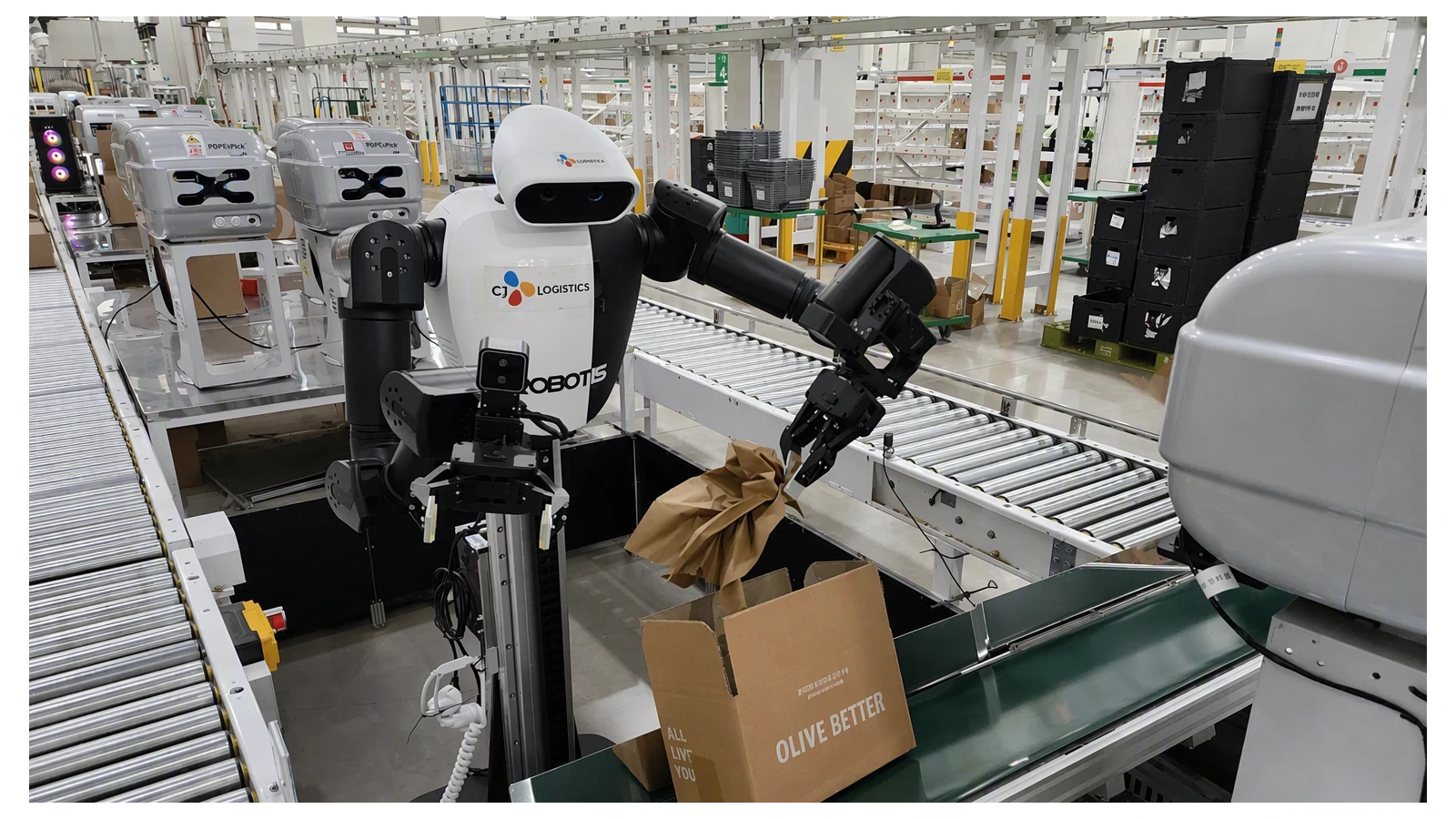
CJ Logistics said on September 3 that it had placed two dual-arm humanoid robots into the packaging process at the Yangji Olive Young distribution center in Yongin, Gyeonggi Province. The robots insert cushioning material into boxes on the line. CJ describes this as a move beyond its 2025 field verification at the Gunpo fulfillment center and into an operating process that handles real customer orders.[1]
Yonhap and The Korea Times report the same two-machine installation, site and task. CJ’s own operating description adds the handoff that makes the stage meaningful: after the robots add cushioning, workers put the ordered products into the boxes and those parcels continue to customers. This is a narrow task, but it is no longer only a technology demonstration or a controlled feasibility test.[1,2,3]
The task is narrow, but the integration is real
The operator’s reason for using a humanoid is the variability of fulfillment work. Distribution centers handle products with different shapes, sizes and materials, while orders change the work conditions. CJ says fixed conveyors and robots can be productive for defined processes but may require equipment or workspace changes when a new task is added. A human-shaped machine can use an existing human-oriented station and potentially move between processes.[1,2]
The surrounding system matters as much as the two arms. CJ identifies ROBOTIS as its hardware partner, Aidin Robotics for robot-hand technology and RealWorld AI for the robot foundation model. It says the model combines field logistics data with simulated data so the robots can improve their response to new products and work environments. That is a development loop attached to a live line, not proof that the loop has already generalized across warehouses.[1,3]
The current assignment is still one repetitive action: putting void-fill material into a box. CJ says it wants to expand later into picking, sorting, inspection and other packaging work, with a long-term goal of one humanoid performing several logistics processes in sequence. Those are future plans. The public record does not say how long the Yangji machines have been operating, how many boxes they handle, or how often a worker must correct or reset them.[1,2,3]
What operators can conclude
The decision change is concrete: a South Korean logistics operator has integrated two humanoids into a named customer workflow and assigned them a production-line task. That establishes a buyer-side operating boundary, a facility handoff and a human-robot division of labor. It is stronger evidence than a staged demo because the output enters an ordinary fulfillment process, even though the announcement does not establish that the machines are replacing the full packing job.[1,2,3]
The missing denominators are the limit. CJ, Yonhap and The Korea Times do not publish boxes per hour, active operating hours, uptime, exception or rework rates, manual interventions, staffing changes, acquisition cost, maintenance burden or payback. Without those measures, the deployment proves that a narrow action can be inserted into a live customer process; it does not prove that a general-purpose humanoid is economically or operationally ready for a warehouse-wide role.[1,2,3]
The next checkpoint
The next useful update is a customer-side operating record: boxes per hour, scheduled hours, exception rate, human intervention and reset frequency, labor hours around the station, and the cost of keeping the line running. A second process, a larger unit count or a measured expansion from cushioning into picking or inspection would test the flexibility claim. Until that evidence appears, the defensible conclusion is two humanoids on a live packing line—not a warehouse staffed by humanoids.[1,2,3]