The cash question comes before the ranking
A warehouse automation supplier can report strong earnings, positive cumulative cash and a negative quarter at the same time. Those statements answer different questions. This report tests whether public cash measures from KION, Symbotic, AutoStore and Daifuku can support a common cash-conversion ranking. They cannot without further reconciliation. The useful result is a map of the definitions and time windows a buyer or analyst must check first.[1,2,3,4,5]
KION: a forecast change is not a warehouse cash result
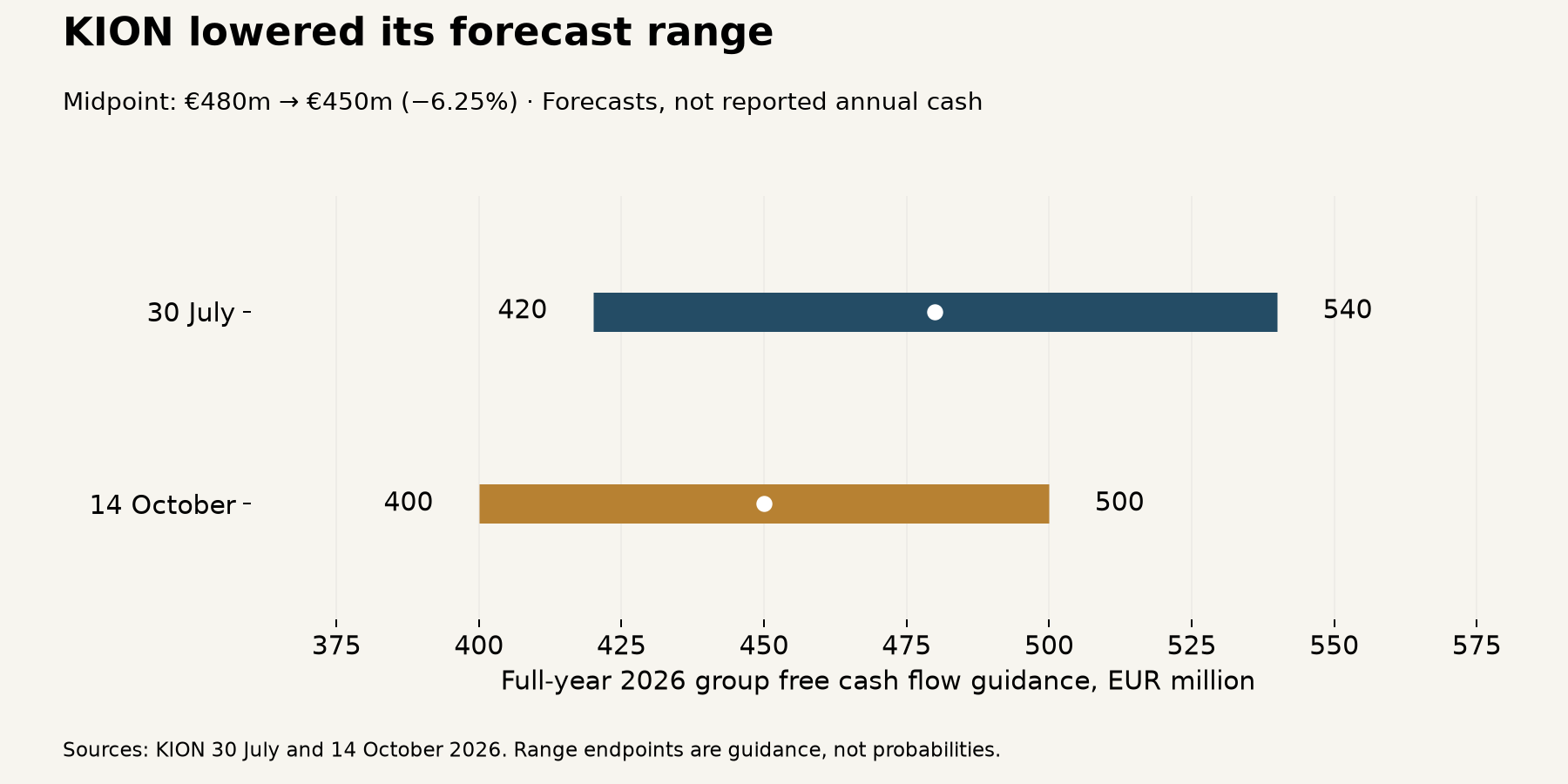
KION’s 14 October preliminary announcement reduced 2026 group free cash flow guidance to €400–500 million, from €420–540 million in July. The midpoint falls from €480 million to €450 million, a 6.25% reduction. These are management forecast ranges, not measured annual outcomes or probability intervals.[1,2]
The company attributes the outlook adjustment mostly to orders in Industrial Trucks & Services that did not materialize as expected. Its Intelligent Automation Solutions segment’s preliminary revenue and adjusted EBIT were in line with market expectations. The group cut therefore cannot be presented as proof of weakness in warehouse automation.[1]
The earlier half-year release reports €22.2 million group free cash flow. Its definition combines operating and investing cash flows with debt-financing receipts and payments for the lease business. It also describes acquisition and efficiency-program cash payments. Comparing this group measure directly with a warehouse supplier’s operating cash flow would mix business scope and financing treatment.[2]
Symbotic: isolate the quarter from the cumulative total
For its quarter ended 27 June 2026, Symbotic reported operating cash outflow of $147.297 million. The nine-month total remained positive at $305.584 million. Subtracting the quarter from the cumulative result gives $452.881 million for the first six fiscal months. The fiscal periods matter: this is not a calendar first-half comparison.[3]
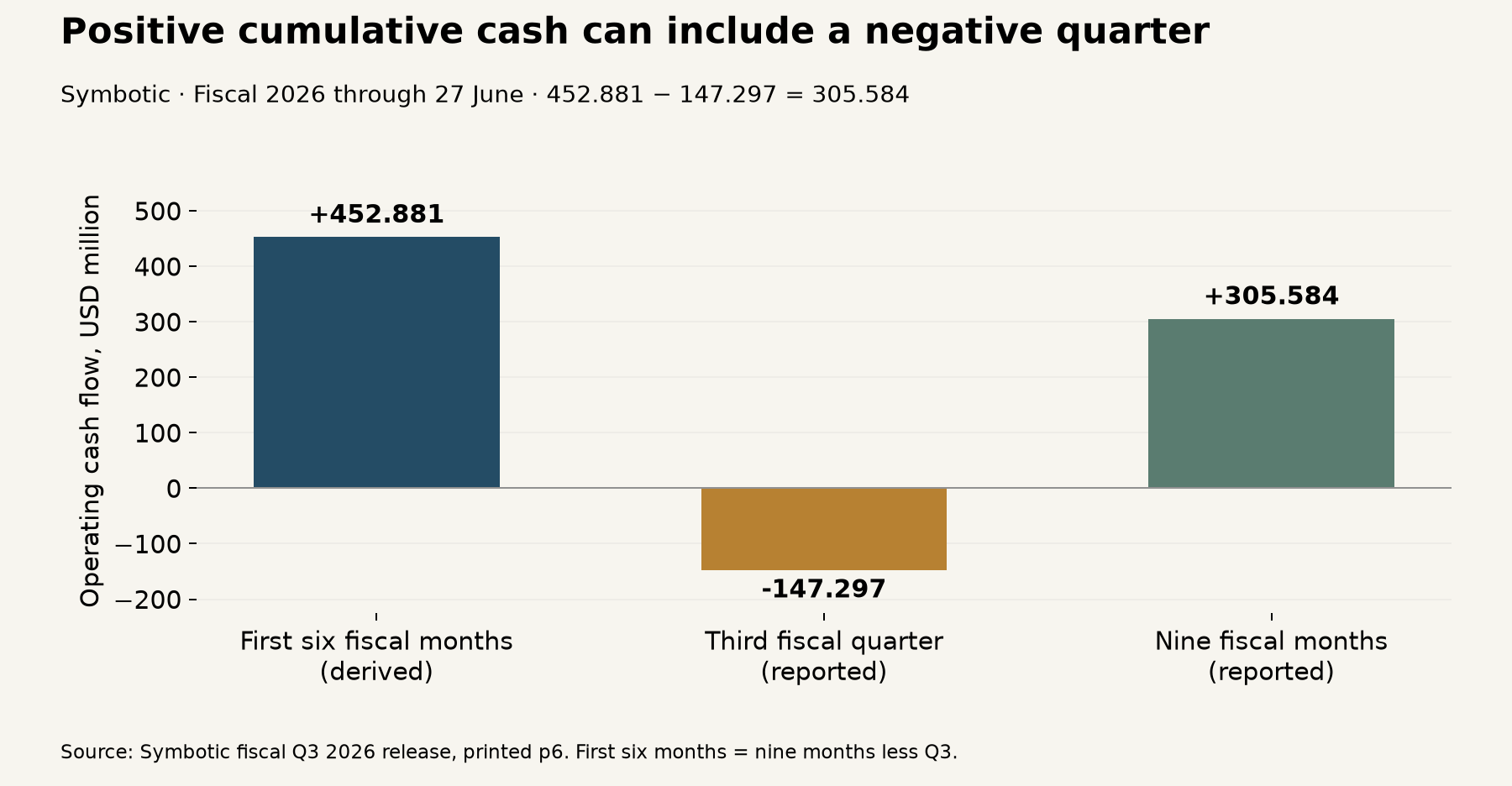
The cumulative positive number does not prove cash generation was steady. Equally, one negative quarter does not establish financial distress. This calculation isolates timing; it does not identify a single cause, forecast the next quarter, or turn customer orders into collected cash.[3]
AutoStore: read the numerator before quoting conversion
AutoStore defines simplified free cash flow as adjusted EBITDA less cash capital expenditure. For the first half of 2026, adjusted EBITDA was $159.1 million. The cash-flow statement shows $2.1 million for property, plant and equipment, $5.5 million for intangibles and $19.3 million for development, totaling $26.9 million. The resulting $132.2 million gives 83.1% conversion after rounding.[4]
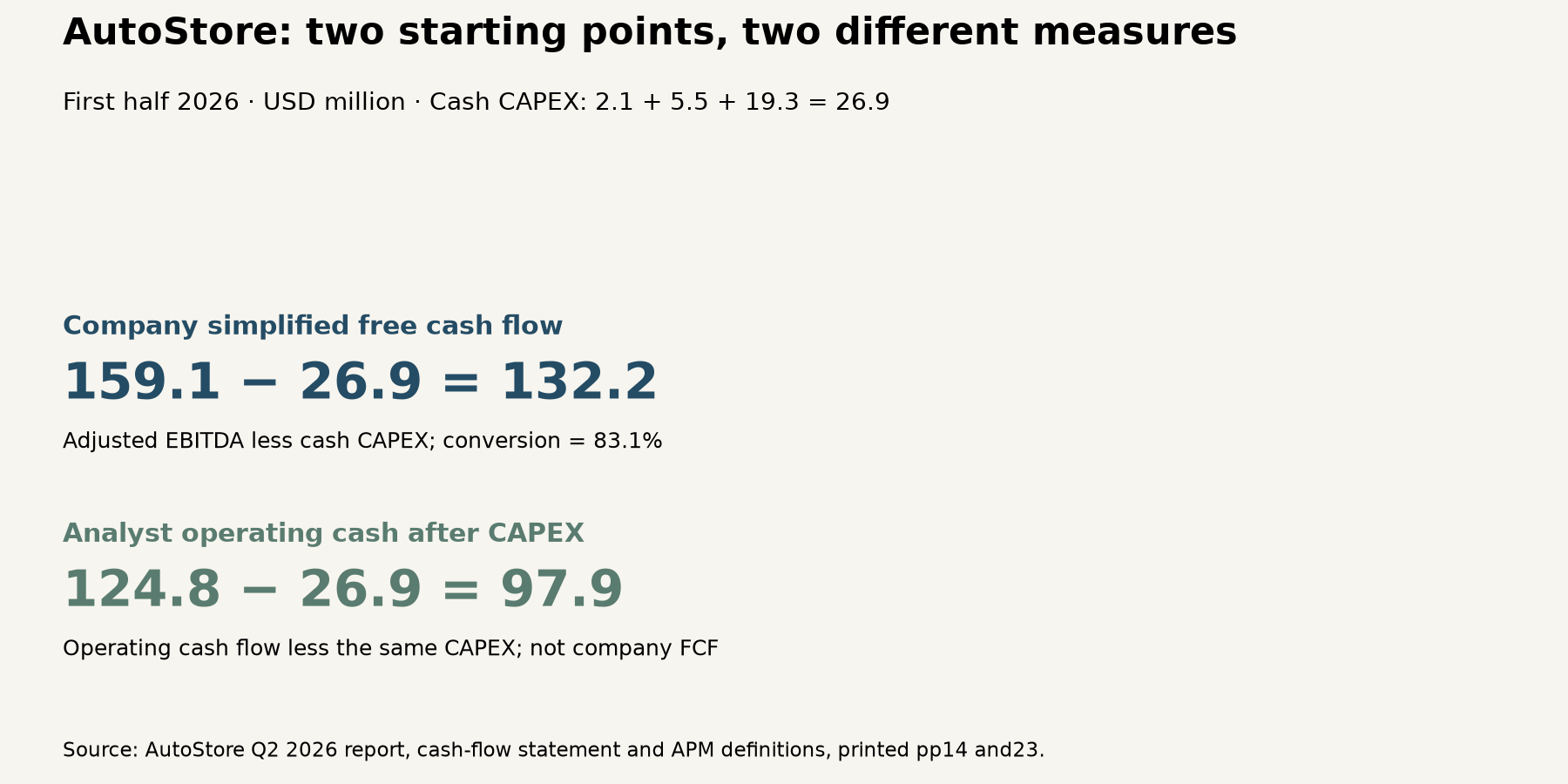
Reported operating cash flow was $124.8 million. Subtracting the same $26.9 million gives $97.9 million, a separate analyst calculation. It is not AutoStore’s simplified free cash flow. The company’s conversion percentage is mathematically consistent with its definition; it does not mean 83.1% of EBITDA became operating cash after capital expenditure. Interest paid is classified in financing, another boundary to preserve.[4]
Daifuku: consolidated cash is not warehouse-only cash
Daifuku reports ¥52.064 billion operating cash flow for January–June 2026, compared with ¥44.350 billion a year earlier, under Japanese accounting standards. Its consolidated business includes cleanroom, airport and other material-handling activities alongside warehouse systems. The figure provides evidence about the group, not an isolated warehouse cash margin.[5]
The geographic panels therefore remain separate: Germany-based KION’s group measure, US-based Symbotic’s fiscal periods, Norway-based AutoStore’s alternative performance measure and Japan-based Daifuku’s mixed scope. These are issuer-reporting comparisons, not national productivity estimates. Converting currencies would not reconcile the underlying definitions.[1,2,3,4,5]
What the next disclosure should settle
We selected five substantive issuer records from four publisher families and used KION’s 14 October announcement as the fresh anchor. We recalculated forecast midpoints, a cumulative-to-quarter bridge and two AutoStore measures. The CSV preserves units, reporting windows and source locators. No cross-company ratio, causal cash explanation or investment forecast is estimated.[1,2,3,4,5]
The base scenario is that these reporting differences persist: procurement diligence should request a matched-period cash bridge, project milestones and explicit working-capital treatment. If later disclosures supply comparable warehouse-only cash statements and reconciled capital spending, a narrower comparison becomes possible. If forecasts weaken further, that changes expectations; it still requires observed cash before claiming an outcome.[1,2,3,4,5]
On 29 October, compare KION’s full quarterly release with the preliminary figures and confirm the cash definition. In Symbotic’s next annual disclosure, subtract the nine-month operating cash total from the full-year total to isolate the fourth fiscal quarter. For AutoStore’s next report, rebuild simplified cash conversion from its stated EBITDA and capital spending, then keep the operating-cash calculation separate. These tests can revise the numbers; they do not remove the need to match definitions.[1,3,4]
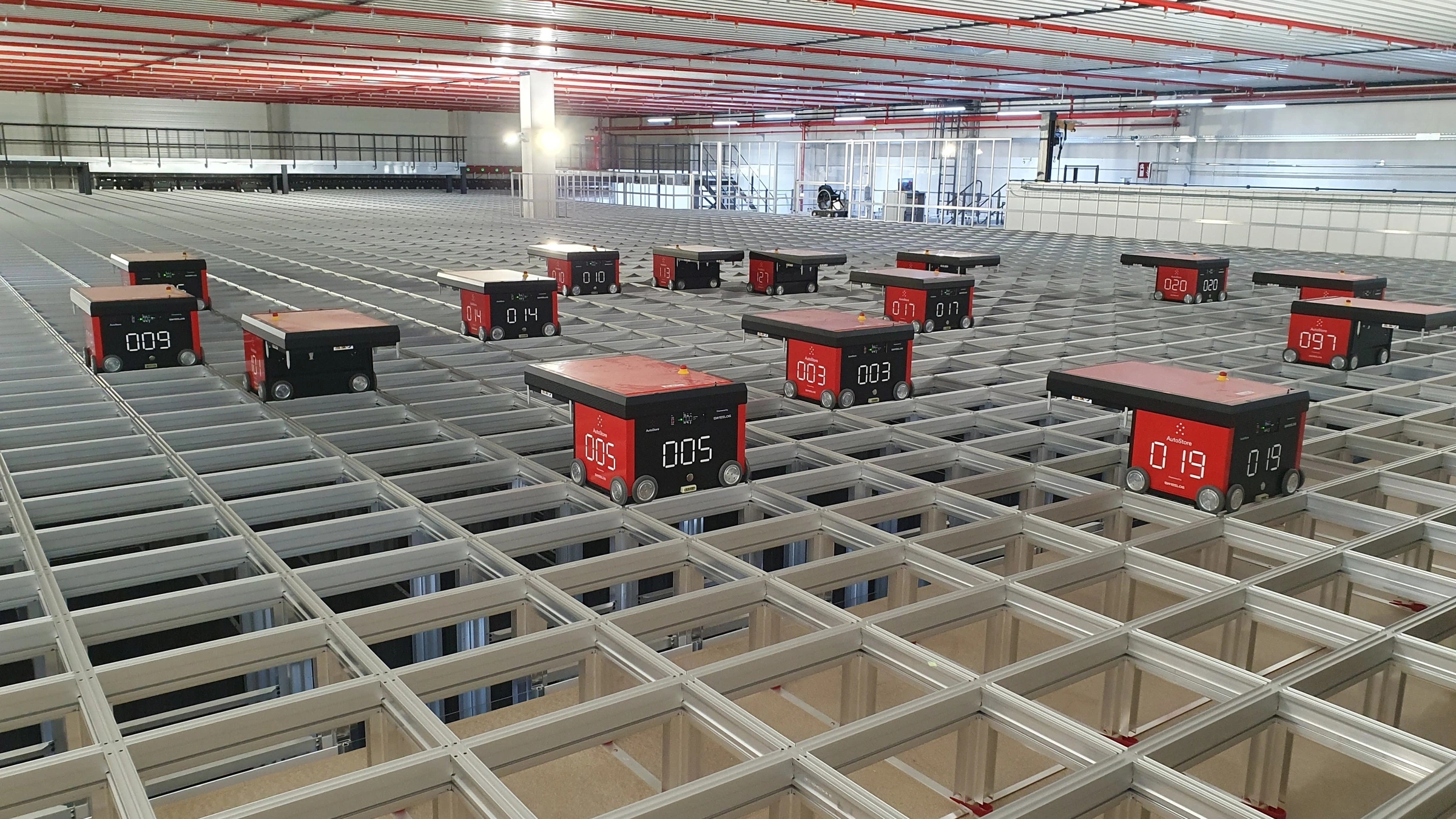
Cover context: AutoStore robots on an indoor grid, photographed by Euku on 18 July 2025. This archive image illustrates the equipment category; it is not a 2026 KION event or evidence of a particular financial outcome. Source: Wikimedia Commons, CC BY-SA 4.0; cropped and resized, with the derivative photograph under the same license. No location is asserted.[6]
