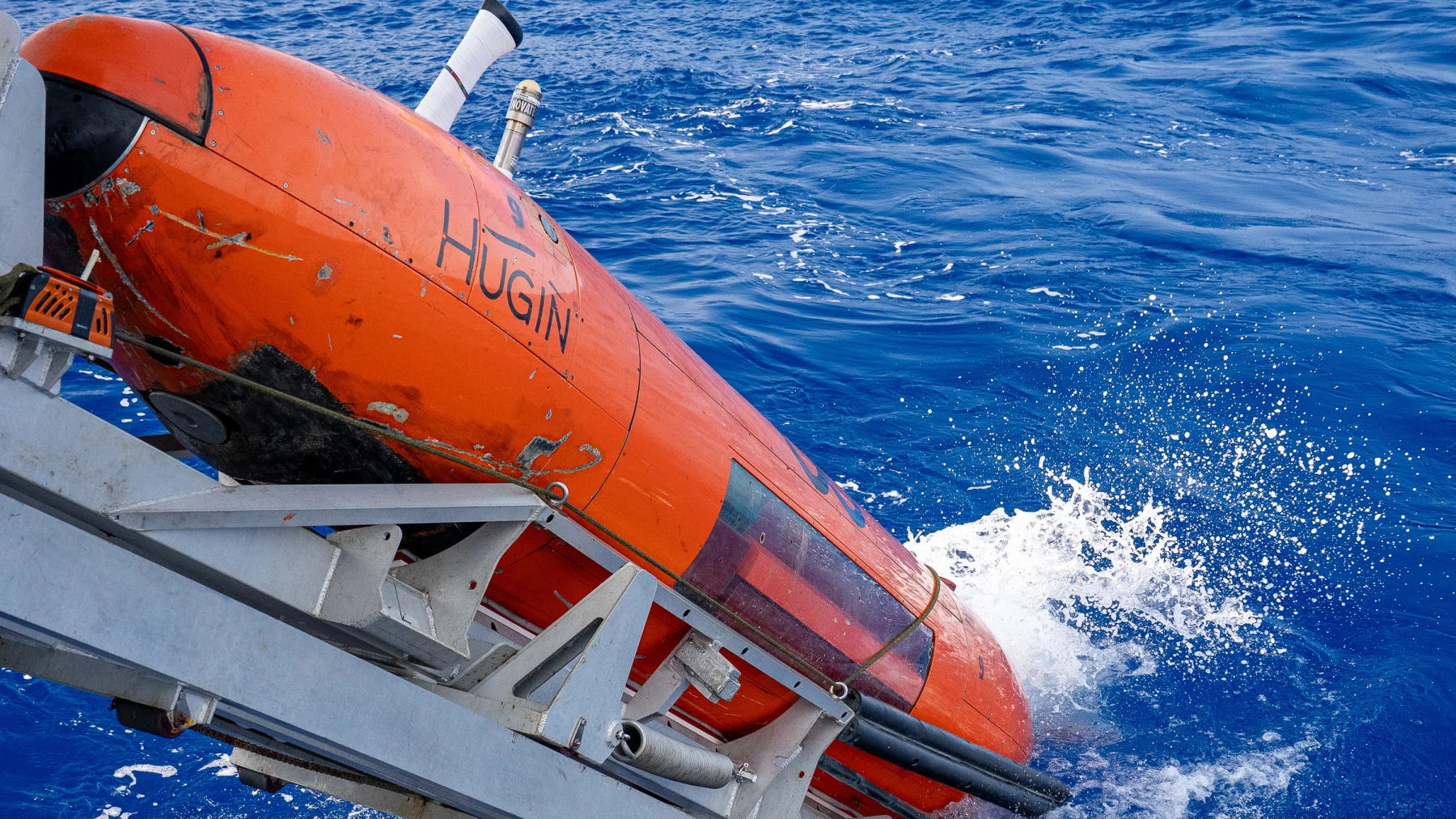
NOAA Ocean Exploration published photographs on November 13 showing a HUGIN 6000 launching from Okeanos Explorer and being recovered at night. The Hawai‘i trial tests how a long-range mapping robot and two smaller Orpheus vehicles fit into routine ship operations. The photos document two important operations for bringing the HUGIN into regular use. Dive durations, executed survey distance and accepted coverage remain open questions in the material reviewed.[1,2,3]
An earlier cruise logged the time at the bottom
In May 2025, the Ocean Exploration Trust’s NA171 cruise near the Mariana Islands recorded six Orpheus dives totaling 68 hours. The team logged 16.6 hours of seafloor exploration, about 24% of total dive time. The remaining 51.4 hours were outside the reported seafloor category. Two dives were engineering tests. The other four reached 5,600 to 5,700 meters.[4]
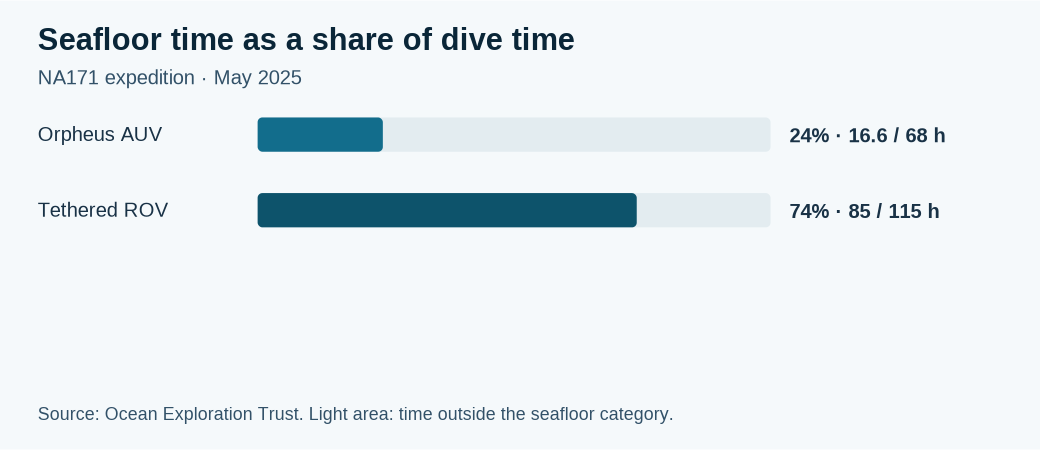
The same cruise reported 85 hours of seafloor exploration across 115 hours on nine successful tethered robot dives. Those dives ran at different depths and served different science tasks. The 74% share supplies a second example of the same accounting method. It gives no basis for transferring either share to Hawai‘i or assuming that all the hours at the bottom yielded accepted data.[4]
Start with time on the survey line
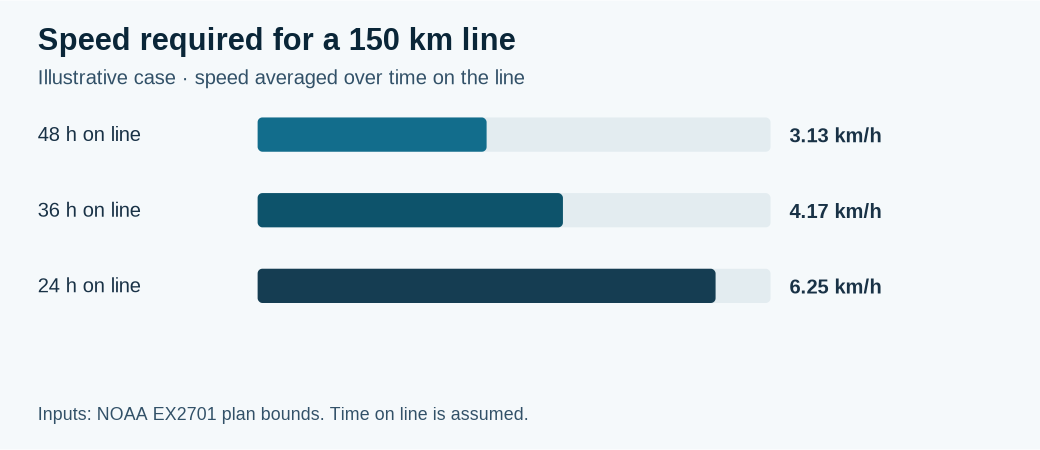
NOAA’s EX2701 plan names tracklines up to 150 kilometers and HUGIN deployments up to 48 hours. For a planning exercise, suppose one sortie includes a full 150-kilometer line and all 48 hours are available. With 12 hours allocated to everything off the line, completing it takes an average of 4.17 km/h on line. With 24 hours allocated elsewhere, the requirement rises to 6.25 km/h. Neither scenario establishes what the HUGIN can sustain with its sensors running.[1]
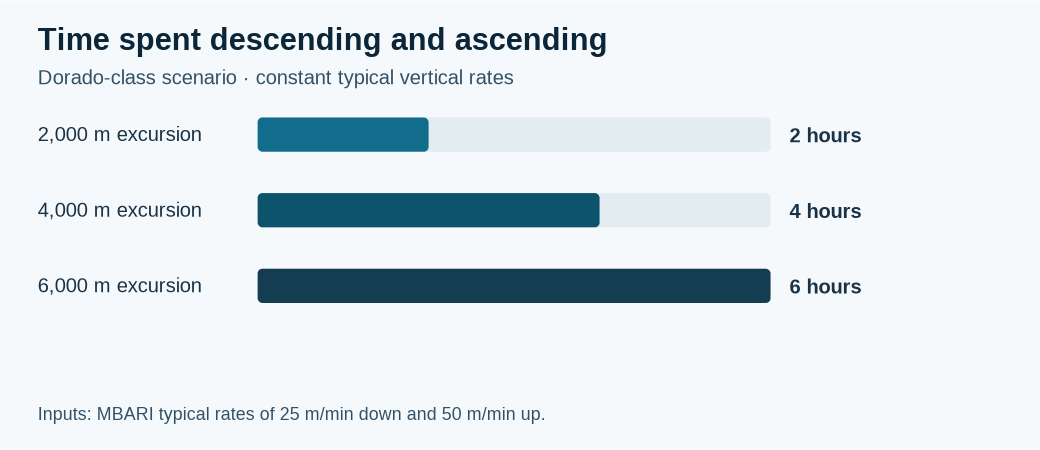
The Monterey Bay Aquarium Research Institute publishes typical descent and ascent rates of 25 and 50 meters per minute for its separate Dorado-class mapping vehicles. At a hypothetical 6,000-meter vertical excursion, those rates imply six hours for the round trip before survey or surface handling. That is about 32% of its published 19-hour endurance if the rates held throughout. The calculation illustrates why each vehicle needs its own mission budget, including depth and dive profile.[5]
What to require before adding a robot
For the next cruise, ask for launch and recovery timestamps, time on line or at the bottom, and output that passed the required coverage, resolution and positioning checks. Include engineering and aborted sorties. Measure accepted output per vessel day and record hours when the robot and ship can work concurrently. Giving both the vehicle and ship credit for the same elapsed hour would overstate the time consumed.[1,4,5]
The next EX2701 release can test this approach against logged dive phases and accepted products. Measure whether the robots add usable coverage or sampling within the planned vessel days. NOAA says expedition data are submitted to its public archives within 120 days of completion. Check the archive in mid-March if the cruise finished on schedule, then use the accession and matching dive logs to rerun the calculation.[1,4]