The warehouse crossed the demo line
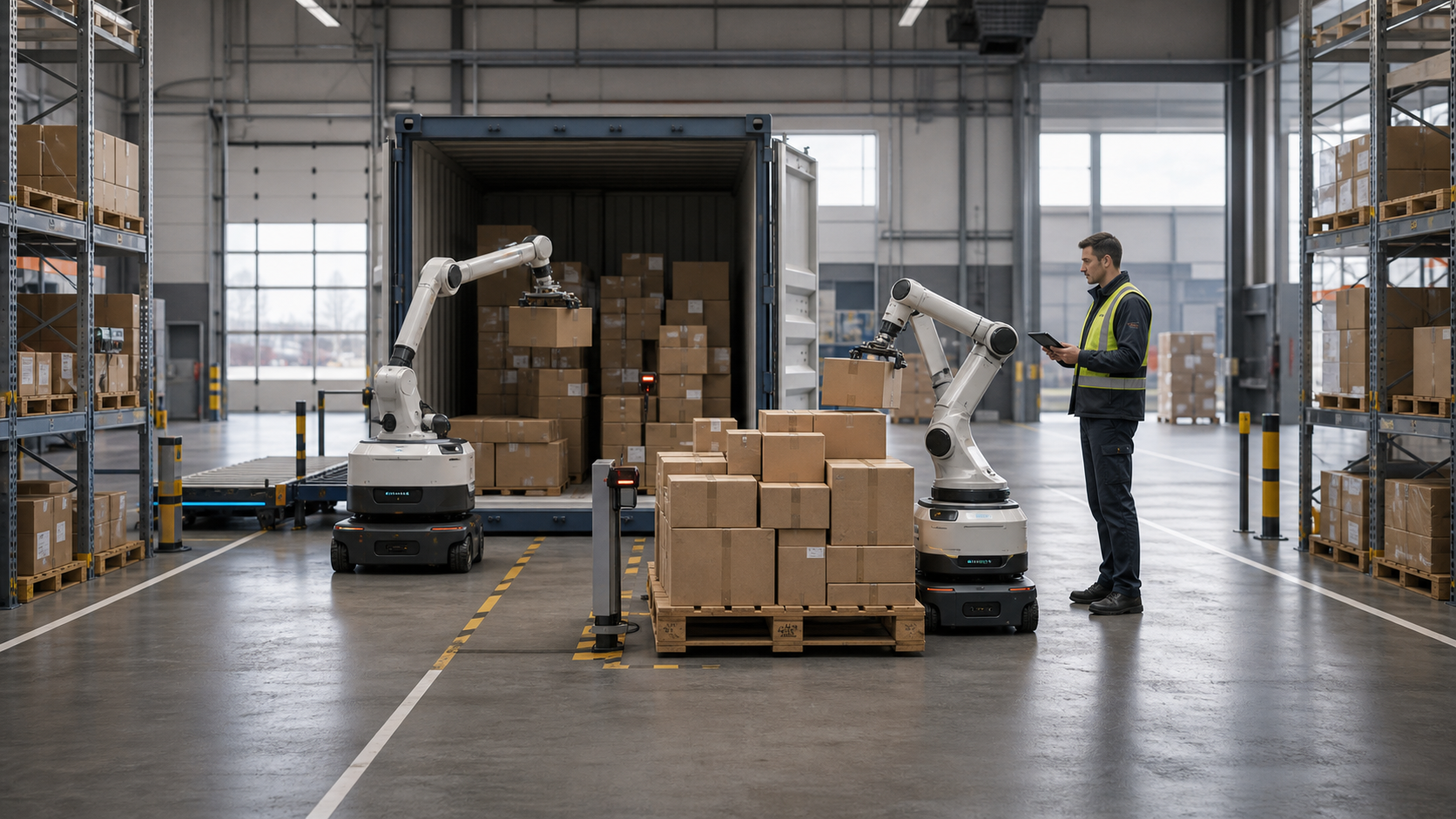
BAUHAUS says its import and central warehouse in Krefeld, Germany, is now using XYZ Robotics’ Rocky system to unload shipping containers, sort cartons and build pallets in one connected goods-receiving process. The site supplies BAUHAUS stores across Europe and handles thousands of inbound shipments involving more than 10,000 articles, according to the retailer’s current company news page. The important distinction is stage: this is presented as an operating customer workflow, not a planned installation or a trade-show demonstration.[1,2,3]
The public record is still a customer-and-vendor description rather than an operating log. BAUHAUS says the system has run reliably and autonomously since commissioning and that it is examining other uses in its network. The independent diy-online report confirms the news event and the robot-handled receiving process, but it does not add a robot count, throughput, intervention rate or cost result. The deployment is therefore strong evidence that the workflow exists; it is not yet evidence that Krefeld’s economics or performance travel to other warehouses.[1,3]
What is actually being automated
XYZ Robotics describes RockyOne entering a container and handling loose cartons with vision, while barcode scanning and RockyOne SE sort the goods into prescribed pallet patterns. Operators supervise the flow through a tablet. That stack matters more than the arm alone: the deployment has to recognize variable carton geometry, sequence the next pick, place items without destabilizing a pallet and keep a person in the loop when the expected scene breaks. The company materials describe the mechanism, but they do not publish how often the operator intervenes or how the system behaves on damaged, occluded or unfamiliar packaging.[2]
That is why the Krefeld announcement is more consequential than another autonomous-arm demo and less complete than a measured rollout. A container is an adversarial workcell: cartons arrive in changing positions, labels face different directions, pallet patterns impose downstream constraints and the receiving dock cannot wait indefinitely for a recovery. The operating layer includes camera placement, scan confirmation, motion limits, layout, training, maintenance and remote support. Those integration decisions are part of the deployment and will determine whether a robot removes work or simply moves exception work elsewhere.[2,4]
Japan supplies the missing operating context
The same robot family has a more concrete public operating record in Japan. SG System and Sanwa Supply say RockyOne began operating at Sanwa Supply’s West Japan Logistics Center in May 2026, following an East Japan deployment in 2025. Their release describes mixed-load support, camera-position changes, arm-speed control for collision avoidance, layout optimization, operator education, manuals and remote support. It also says the West site’s maximum processing capacity improved by about 15 percent against the East site. These are company-reported deployment details, not an independent audit, but they show the work required to move from a robot installation to a usable receiving process.[4]
TECH+ adds the benchmark that BAUHAUS has not released. Reporting from Sanwa’s East Japan briefing, it cited 426 items per hour for RockyOne versus 366 items per hour manually and said a typical two-to-three-person container crew was no longer needed. The comparison is useful as an operator question, not as a BAUHAUS result: the sites, carton mix, measurement period and staffing definitions are different. Still, the figures identify the denominators that matter. A buyer needs to know whether the new European system improves actual receipts per hour after exceptions, handoffs, cleaning, maintenance and downtime are counted.[4,5]
The denominator still matters
The decision delta is therefore narrower than “warehouse robots are arriving.” Europe now has a named retailer saying a mobile manipulation system is operating in the mixed-carton receiving edge of a central warehouse. Japan provides a related operating reference with reported staffing and throughput measures. What is still missing is the bridge between those facts: Krefeld’s robot count, receipts per hour by carton class, first-pass scan rate, exception and intervention rate, uptime, maintenance hours, injuries or near misses, labor-hour change, capital cost and payback.[1,2,4,5]
That missing bridge is material for BAUHAUS, XYZ Robotics and the people operating the receiving dock. BAUHAUS’s autonomy statement may be accurate for its defined workflow, but “fully autonomous” does not establish zero exceptions across every carton or shift. The Japanese numbers may be directionally encouraging, but they cannot be transferred to Krefeld without a common baseline. The honest commercial reading is that the deployment has crossed into customer operation while its repeatability and economics remain unproven in public evidence.[1,4,5]
The next proof point
The next catalyst is not another product video. It is a BAUHAUS site-level operating record or a confirmed second-site rollout that publishes a common denominator: installed units, carton mix, receipts per hour, intervention rate, uptime, maintenance burden, staffing change and cost per completed receipt. Until that record appears, the strongest provable story is already specific: Rocky has moved from laboratory promise to mixed-carton receiving at named customer sites, but the metric that decides whether the operating model scales—throughput after exceptions—remains withheld at Krefeld.[1,2,3,4,5]