Three robots are operating on a live line
Guangzhou Daily’s August 19 account puts the story at the production-line level: three embodied sorting robots were already on duty at China Post’s Jianggao Mail Processing Center after 13 had been introduced there since March. The center’s maintenance manager told the paper that the reported feed rate rose from 300 parcels an hour to 1,200. That is a live workflow claim, not another exhibition-floor demonstration.[1]
The task is bounded. The robots feed mixed parcels, use 3D binocular vision and multimodal perception to identify damaged or malformed items, and route exceptions to an irregular-item process. Workers remain responsible for exception handling and equipment maintenance. The same report says 21 of the center’s 28 small-item feed stations are planned for intelligent robots and flexible arms, while seven remain human fallback positions.[1]
The record is not one fleet number
The unit count should not be flattened. An August 12 Guangdong Postal Administration account described eight humanoid robots at the same center, 21-hour operating days and a 1,200-parcel-per-hour peak. An August 17 Xinhua Finance report described autonomous feeding at 800 parcels per hour and a plan for 1,600 by the second quarter of 2027. Guangzhou Daily’s newer field report separately says three are currently operating and 13 have been introduced. These may describe different moments or categories, but the sources do not publish a common station-level denominator. This brief therefore treats three live robots as the current reported subset, not the total fleet.[1,2,4]
China Post’s own July procurement record shows that the deployment required physical integration. Three feed tables on the double-layer sorter were to receive bottom scanners so robots could feed parcels without turning them over. The direct-procurement rationale cites original equipment interfaces and maintenance continuity. The overlooked operating layer is clear: the robot is entering an existing line, and the line is being modified around it.[3]
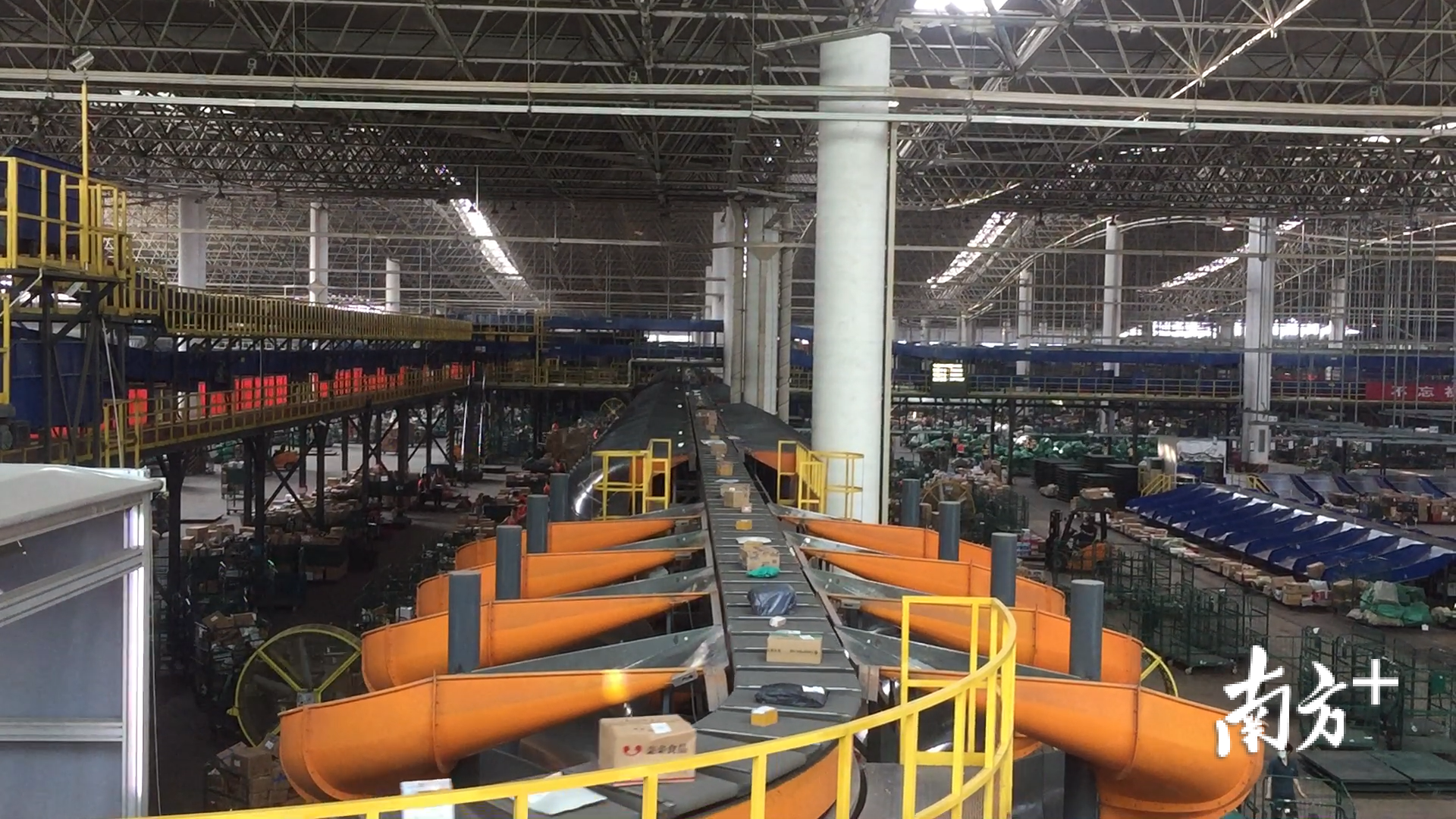
The site is not a greenfield robot warehouse. A 2020 Southcn report documented the same Jianggao center’s double-layer sorter and operations-control platform, including a large automated sorting hall. The current pilot is therefore testing embodied manipulation inside a mature high-volume workflow, where the difficult question is not whether parcels can move, but whether the new feed step remains dependable when exceptions, maintenance and existing equipment constraints are counted.[5]
The proof point now shifts to reliability
The deployment is material because a named postal hub is running robots in a live operating environment, but the public record still lacks error rate, uptime, intervention frequency, maintenance hours and cost, unit economics and payback. The reported 1,200-parcel figure appears in both a current operator account and an official peak-rate account, while Xinhua Finance reports 800 parcels per hour for autonomous feeding; the definitions are not reconciled. The next checkpoint is whether the reported fourth-quarter 2026 and first-quarter 2027 rate targets, plus planned system data integration, become measured operating results rather than rollout plans.[1,2,3,4]