What happened
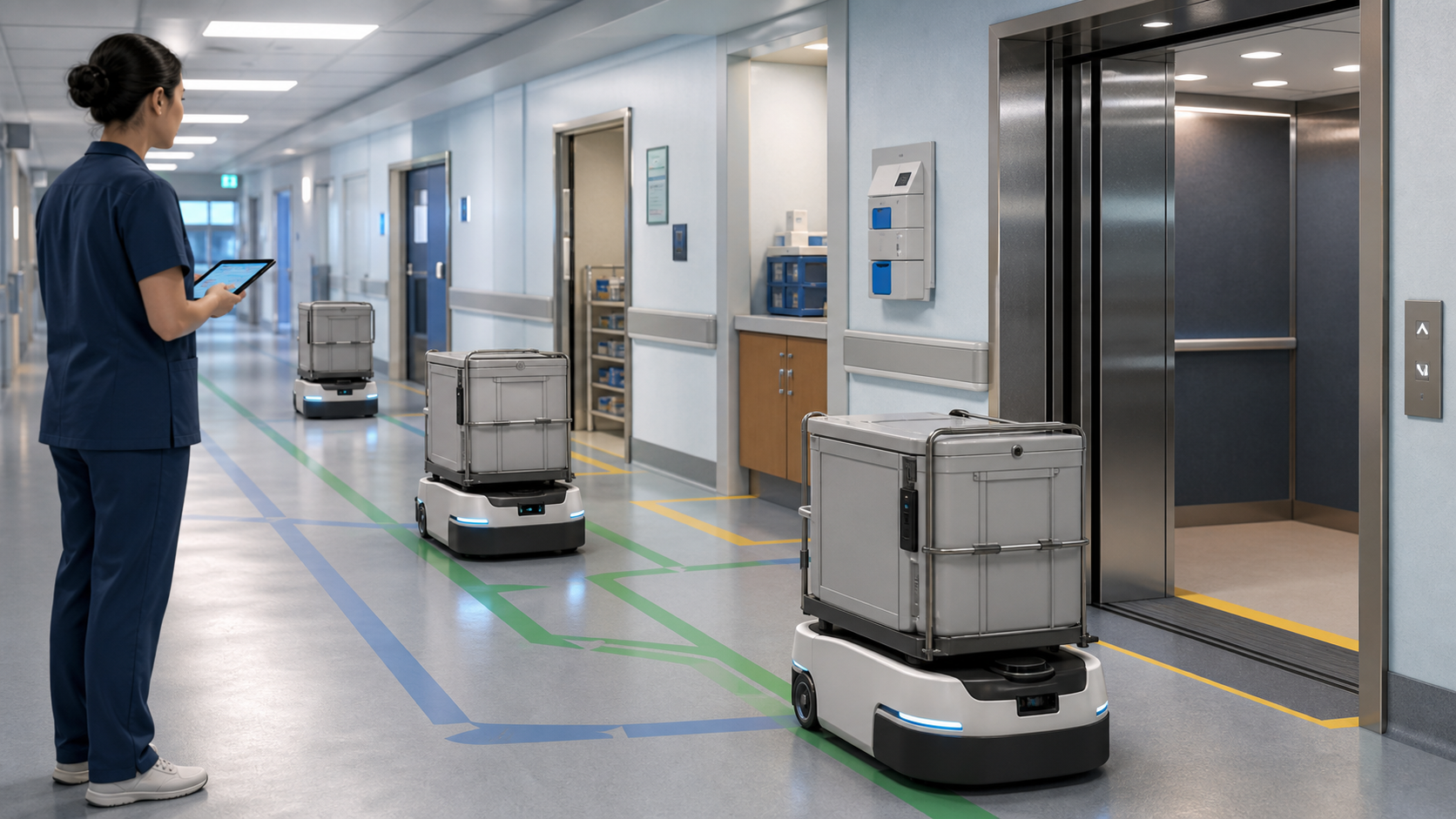
On July 27, deliverz.ai announced that it is taking its hospital logistics platform to healthcare organizations in the United States. The Israeli company is not pitching a single delivery robot. It says its system coordinates autonomous robots, human transporters and hospital workflows across medications, specimens, supplies and meals. The claimed product is the layer that assigns work, routes resources and connects the fleet to doors, elevators, access controls and clinical systems.[1]
The release is an expansion announcement, not proof of a U.S. deployment. It names no U.S. hospital, operating site, launch date, robot count, contract value or customer KPI. Its operating reference is Sheba Medical Center in Israel, where deliverz.ai says autonomous robots move chemotherapy between the pharmacy and oncology units and where the hospital is expanding into lab samples, biopsies and patient transport.[1]
What the evidence shows
The strongest public operating record is more specific than the U.S. announcement. Techtime reported in February that three robots were working in Sheba’s cancer center and had completed about 2,000 autonomous deliveries since December 2025. The reported route crosses buildings, floors and crowded areas while integrating with elevators, doors and gates. That is an operating system with a hospital attached, not a robot moving through an empty demonstration space.[2,4]
An official Gix filing to the Tel Aviv Stock Exchange in July 2025 supplies the earlier primary record: deliverz.ai had won a public tender for up to 30 robots and commercially deployed its first three at Sheba for medicines, blood samples and sanitary equipment. The filing describes one central system coordinating autonomous mobile robots and human couriers, dynamically assigning tasks by location, availability and urgency, while connecting the fleet to elevators, automatic gates and movement between buildings. The later reports add operating volume; the filing establishes the deployment and procurement boundary.[4]
The performance claim also needs to be treated as a range, not a settled number. Techtime reported that chemotherapy transport fell from about 40 minutes to 17 minutes. Medinet’s account of the investor presentation described a baseline of roughly 40 to 45 minutes and a result of 13 to 17 minutes. The July 27 release compresses the result to 40 minutes versus 14. Those figures may reflect different routes, samples or measurement periods, but the opened record does not explain the difference. The defensible finding is a reported reduction in delivery time, not a verified 65-percent or 70-percent site-wide KPI.[1,2,3]
That distinction matters because the hard deployment problem sits around the robot. A hospital must authorize access, connect elevators and doors, protect medication handoffs, sequence urgent and routine work, keep routes open around patients and staff, and decide when a person takes over. Deliverz.ai’s own description and the Sheba reporting both point to hybrid dispatch: robots perform the movement, while people and software keep the workflow usable when the environment, priority or exception changes.[1,2,4]
The current release claims up to four times more throughput and 7.5 times greater cost efficiency than traditional staffing, and it presents software-as-a-service and robotics-as-a-service as the scaling model. Neither independent account supplies the denominators, uptime, intervention count, failed missions, labor hours, maintenance burden, implementation cost or payback period needed to test those claims. The three-robot Sheba record proves that a workflow is running; it does not yet prove a repeatable commercial result across hospitals.[1,2,3]
The operating question
The decision delta is therefore narrower than “hospital robots are arriving.” The new evidence is that an Israeli deployment vendor is selling an orchestration layer built around a live, multi-building hospital workflow, while using that record to open a U.S. market. For buyers, the purchase is less about selecting a robot than about accepting a new control plane for clinical logistics, the integration work it requires and the human exception process that remains behind it.[1,2,3]
The next proof point is a named U.S. hospital operating the system, or a documented Sheba expansion, with a common denominator: robot count, deliveries, median and tail delivery time, intervention rate, uptime, labor hours and cost per completed run. Until that record exists, deliverz.ai has crossed the more important line from robot demo to hospital operation in Israel, but its U.S. scale claim remains a go-to-market plan supported by one early site and vendor-reported metrics.[1,2,3]