NASA’s Dragonfly rotorcraft has rehearsed its first flight at Titan on a computer testbed. The 23 October update reports a real-time sequence on flight-like avionics—the onboard computing and electronics—at Johns Hopkins Applied Physics Laboratory. It combined flight software with simulated camera, inertial and lidar inputs to search for a landing site, circle back and descend.[1]
The mission’s need for autonomy is concrete. The Planetary Society notes that signals take more than an hour to travel one way between Earth and Titan. Ground teams can plan flights, but cannot steer each landing in real time. Dragonfly is intended to move scientific instruments between surface locations rather than remain at one landing site.[2]
A different test from spinning the rotors
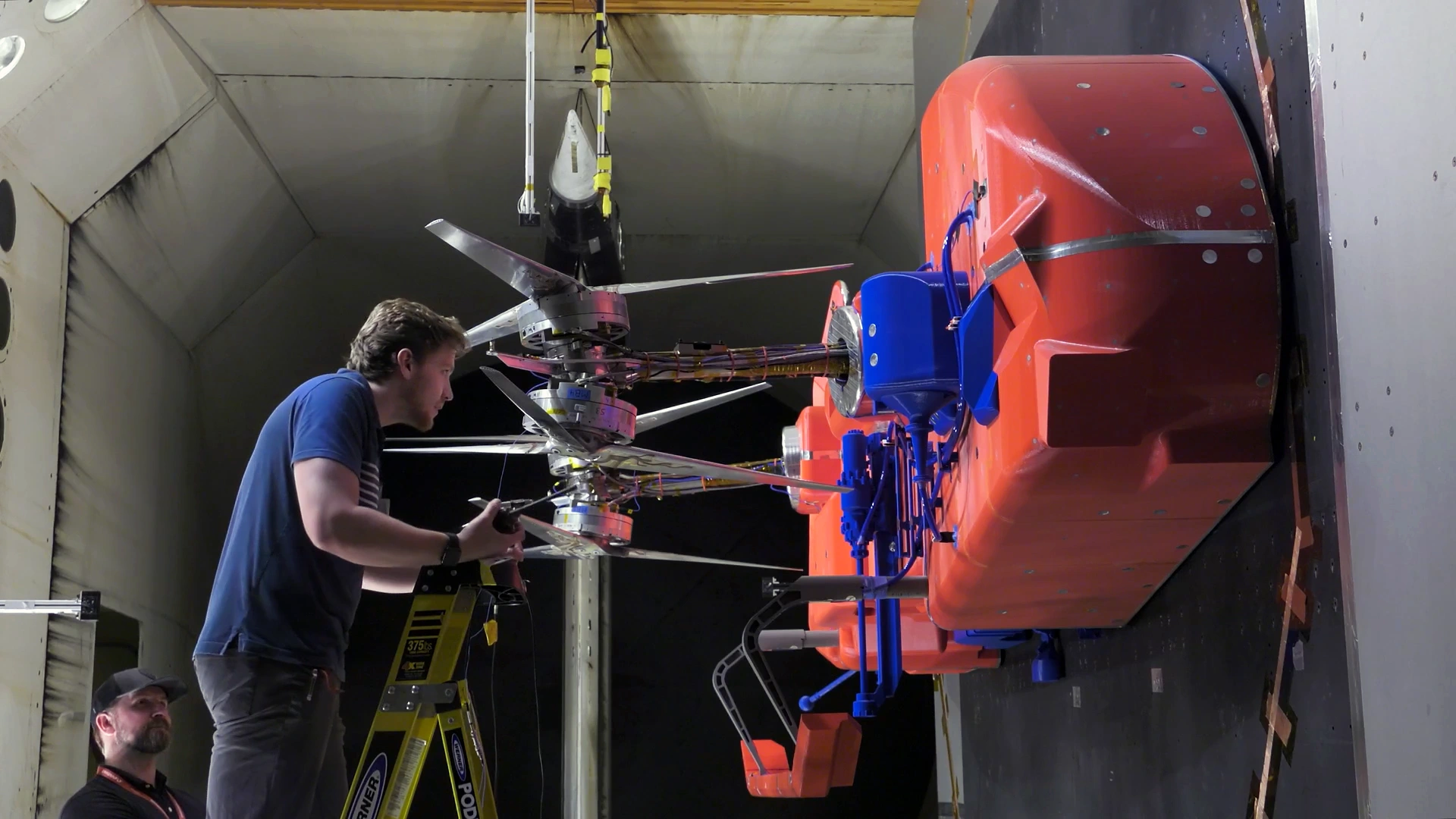
NASA’s 2023 account of wind-tunnel campaigns describes physical tests of rotor aerodynamics and the transition to powered flight, including a half-scale lander model. Those experiments supplied data for simulations and performance predictions. They addressed how the vehicle moves through an atmosphere; the new test brings its computing and simulated perception inputs into one timed sequence.[1,3]
That distinction matters for evaluating autonomous machines. A convincing flight path on a screen is less informative than knowing which hardware runs the decisions and which inputs remain simulated. Here, flight-like electronics execute the sequence while the outside world is generated. The result strengthens the integration evidence, without establishing physical flight performance at Titan.[1,3]
The next evidence is flight hardware and failures
NASA says the team will repeat first flight using Dragonfly’s actual flight system, try other flight profiles and deliberately introduce faults to test autonomous responses. Those are the next checkpoints. Launch remains planned no earlier than 2028, with Titan arrival in 2034; the reported milestone is a ground-based simulation, not mission readiness or a landing on another world.[1,2]
The cover is an archive NASA photograph of engineers adjusting rotors on a physical Dragonfly test model at Langley. Its originating record was updated in September 2025 and does not specify the photograph date. It illustrates the separate physical-testing programme, not the newly reported avionics run.[4]