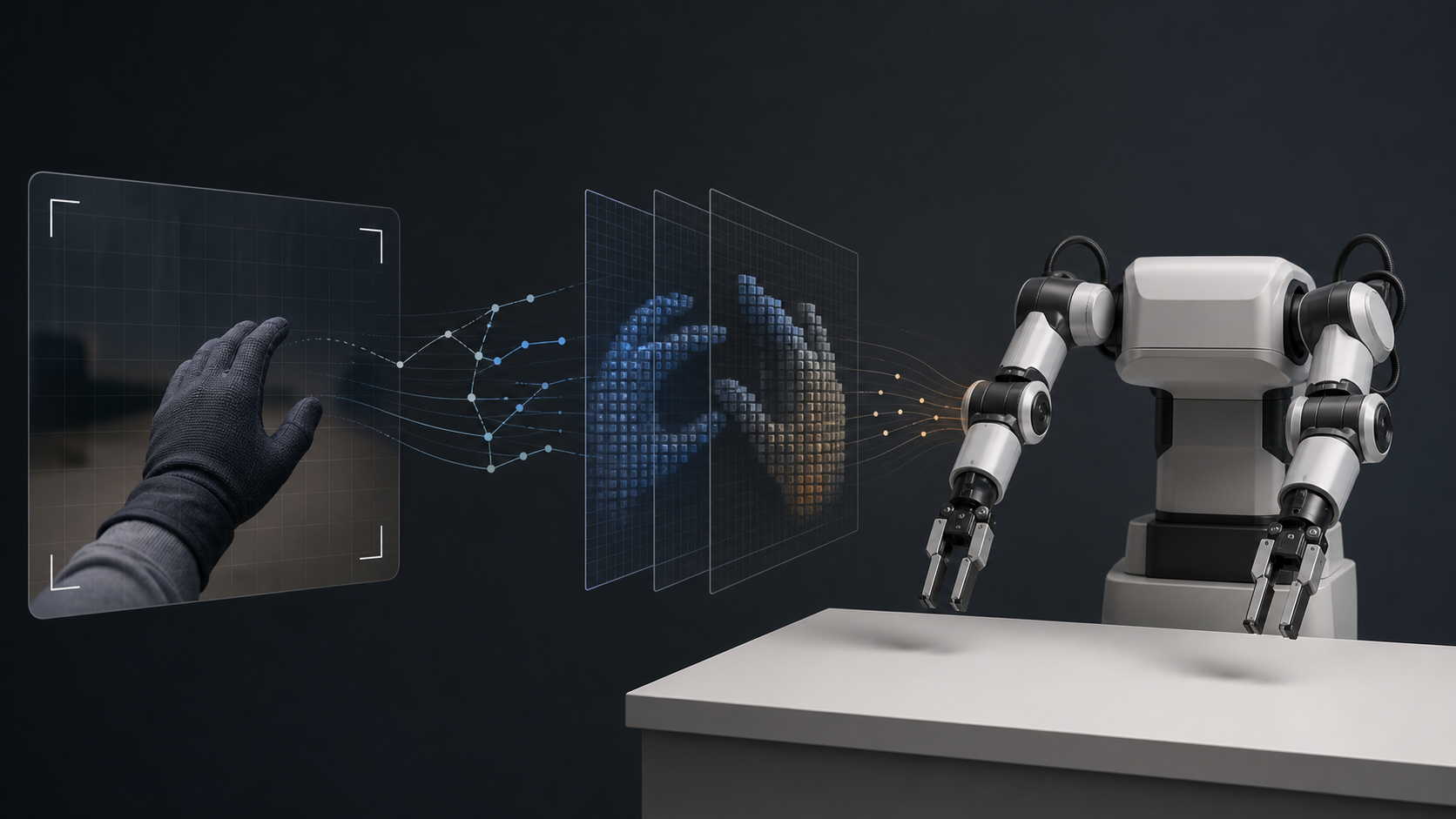
The data multiplier is a rendering result
Ego2Robot is a new preprint from researchers affiliated with Renmin University of China, Alibaba's Qwen Team, ShanghaiTech University, BIGAI and Beihang University. The authors say their pipeline converts egocentric human-manipulation video into robot-formatted training data by retargeting hand motion, removing and rendering arms, solving inverse kinematics and filtering the output. They report processing about 1,940 hours from four human-video sources into 18,561 hours across 15 robot morphologies, then combining it with about 6,565 hours of robot data.[1,2]
That is roughly a 9.6-times data multiplier, but it is not 18,561 hours of new physical robot collection. The same source material is retargeted and rendered for multiple robot bodies. That can be valuable: the paper's randomized RoboTwin score rises from 50.9 percent for robot-only pretraining to 53.5 percent for its one-to-one mix. But the number changes the question from how much robot experience was gathered to whether the synthetic transformations transfer outside the authors' test conditions.[1,2,3]
The physical result is narrow, not absent
The authors did run a physical test, but its boundary is specific. On one ARX ACone dual-arm platform, they used five tabletop tasks, 20 teleoperated demonstrations per task and 20 evaluation trials per task. Their strongest configuration also mixed in about 35 minutes of scene-specific first-person video, converted into 675 synthetic episodes. It reported 31 percent success on putting fruit in a basket, 49 percent on putting blocks in a drawer, 30 percent on folding a towel, 14 percent on sweeping trash and 15 percent on inserting screws. Those are meaningful gains over the paper's robot-only baselines, but they are not a cross-platform or unattended-operation result.[1,2]
The reproduction checkpoint
Ego2Robot uses an extended RoboTwin 2.0 protocol, whose separate authors have published a generator, benchmark, dataset and code. The new paper and its linked project page make the headline method and tables public, but currently link only the paper and a video, not an Ego2Robot code repository, weights, data package or license. The next useful test is an outside group applying the pipeline to a different robot and workplace task, with its own raw videos, intervention rules and full-task failures disclosed. Until then, the evidence supports a promising author-reported data-synthesis result, not a general deployment claim.[1,2,3]