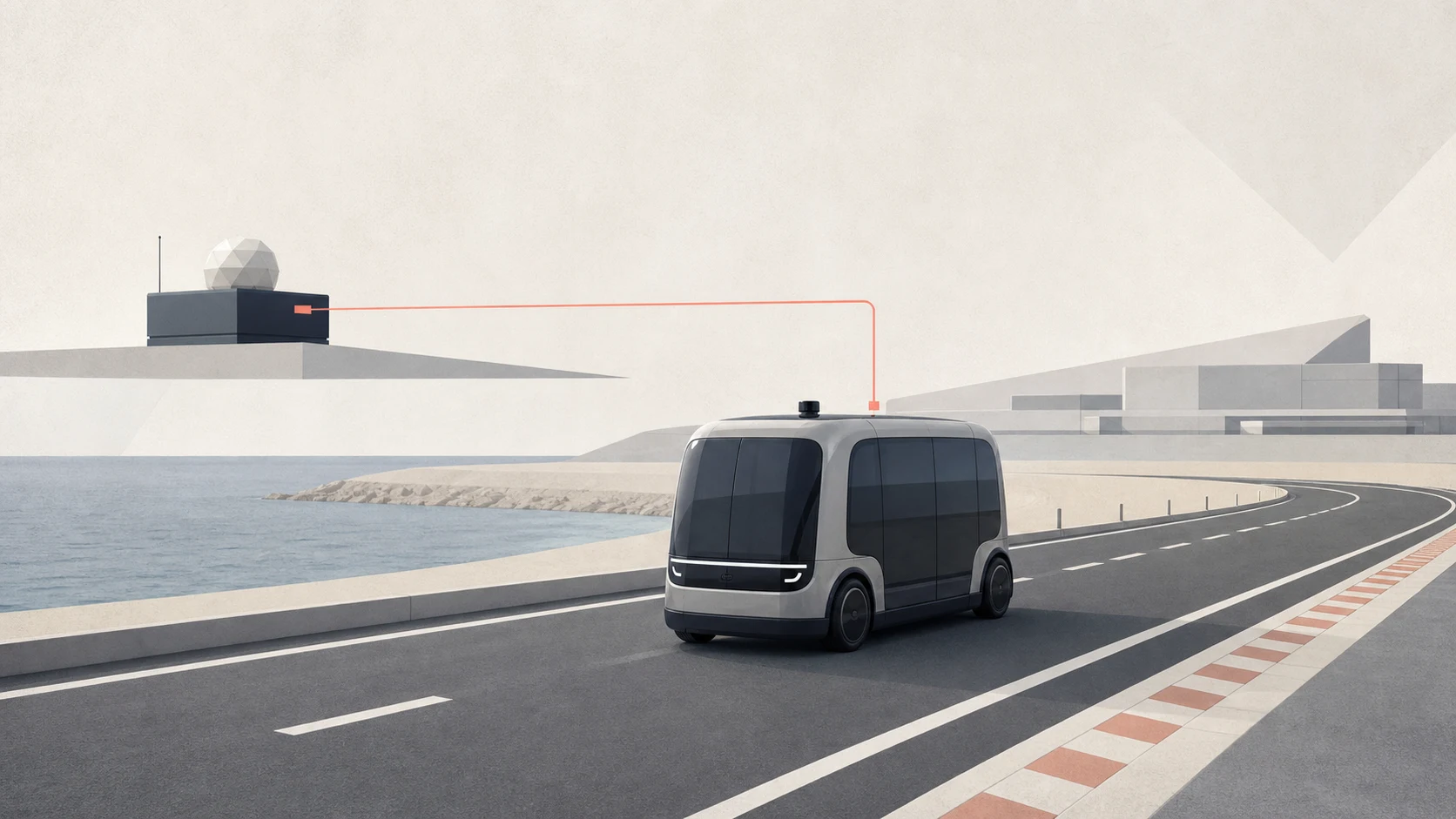
Hong Kong’s Transport Department on July 23 approved an expansion of autonomous-vehicle testing in North Lantau that allows fully driverless tests on Airport Island. Earlier trial conditions required a remote control centre and a backup driver inside each vehicle. After reviewing test reports and conducting site inspections, the department said the vehicles met requirements for safety, stability, accuracy and smoothness. The record describes a trial, not a commercial driverless passenger service.[1,2]
The fallback has moved, not disappeared. Radio Television Hong Kong reports that remote backup operators will continue monitoring individual vehicles from a control centre. The department’s accompanying record keeps other controls in the loop: operators must maintain safety-management and emergency-response plans, carry third-party insurance, install electronic data recorders and display labels identifying a driverless test. The rules also require performance reporting and allow inspections.[2,4]
Decision delta: the ordinary reading was that Hong Kong’s pilots still required a human inside the vehicle; the new evidence is a government-approved shift to remote fallback after earlier tests. The mechanism is a transfer of detection and recovery work from an onboard operator to a remote team, making remote monitoring and the resulting operating record more consequential. RTHK and DotDotNews report eight pilot licences covering 65 vehicles and more than 240,000 kilometres, but those figures do not establish a public service, an intervention rate or performance across bad weather and edge cases.[1,2,3,4]
The next measurable checkpoint is the first fully driverless test record showing remote interventions, incidents, route and weather conditions, followed by any expansion beyond Airport Island. Until then, this is a meaningful deployment-stage approval inside a bounded trial, not evidence that autonomous vehicles are commercially scaled.[1,2,3,4]