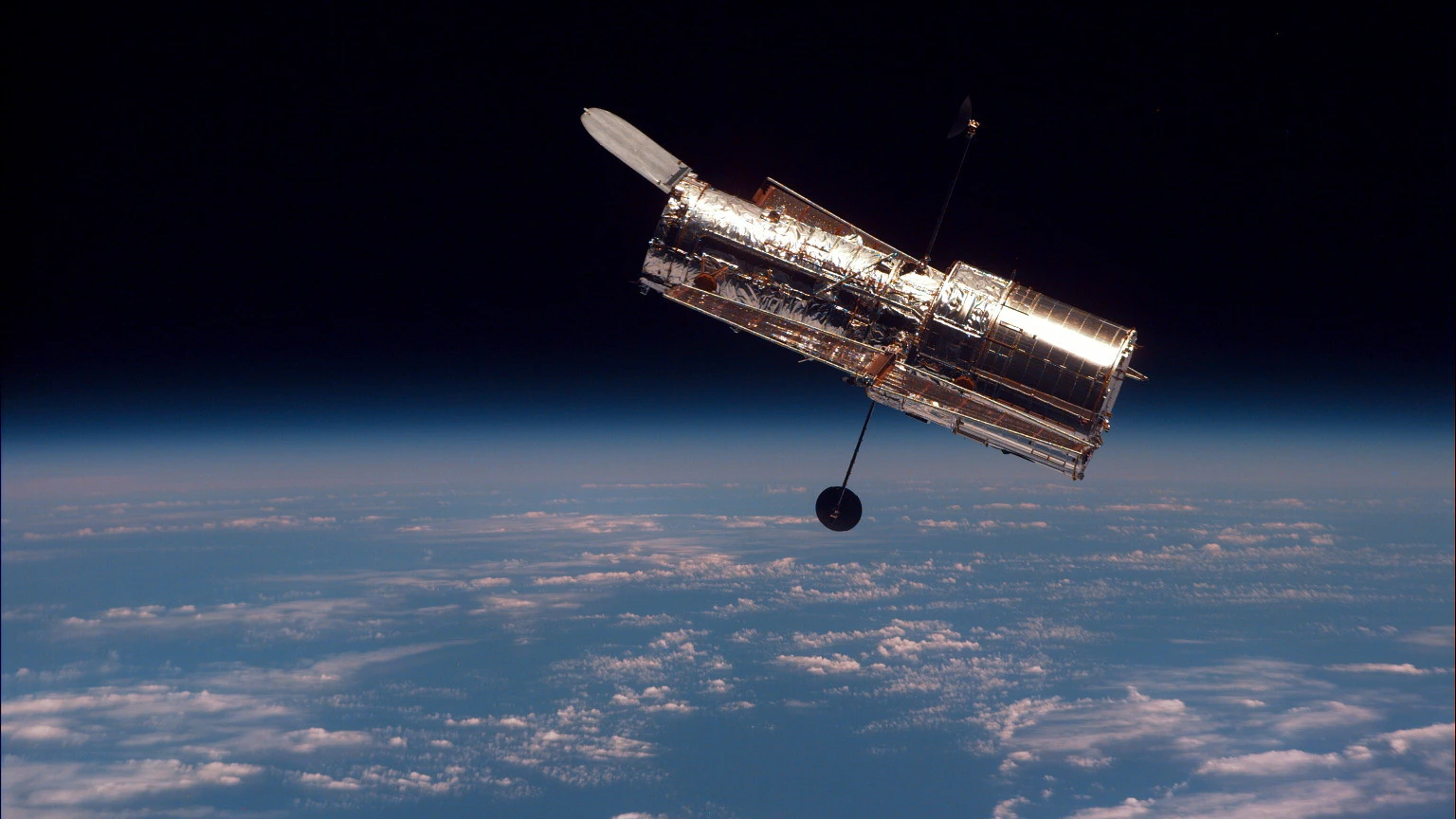
NASA has opened a market test for commercial missions to capture and service the Hubble Space Telescope. Its October 29 information request asks potential suppliers about raising the observatory’s orbit, enhancing its capabilities or guiding it through a controlled reentry. Responses are due November 30 at 3 p.m. Eastern Standard Time.[1,2]
The notice is not a request for proposals and creates no government commitment. For space-robotics suppliers, the immediate opportunity is to demonstrate that a complete mission is feasible, rather than to claim a new servicing contract or a selected robotic architecture. The request explicitly allows crew where applicable.[1]
One option is a vehicle that can capture Hubble and boost it to at least 600 kilometres. The agency expects a boost or servicing mission by 2032 and requires that it not harm the telescope. Hubble lacks propulsion to maintain its own orbit; NASA’s announcement puts likely atmospheric reentry in 2033–2034 without intervention.[1,2]
The engineering questions are more revealing than the headline. NASA asks respondents for rendezvous and capture methods, the readiness of key technologies, allowable telescope rotation rates during capture, time docked and control of the combined spacecraft. Suppliers must also describe mission risk, mitigation, cost, schedule and the resources they expect from NASA.[1]
Hubble has a historical interface intended to make a future capture easier. ESA’s account of the Soft Capture and Rendezvous System describes structures and targets designed for rendezvous, capture and safe disposal by a crewed or robotic mission. That is interface context, not proof that a present commercial vehicle can safely perform the proposed service.[3]
The buyer’s problem therefore extends beyond approaching a target or demonstrating a gripper. A supplier must explain how it captures a moving observatory, controls the joined vehicles and completes the chosen mission without damaging the asset. The notice asks contractors to provide launch, spacecraft and mission operations, while NASA supplies telescope expertise and coordinated operations.[1,3]
The next checkpoint is the November 30 response deadline, followed by any actual solicitation and its technical requirements. Until then, this is demand discovery with concrete capture and control questions. It establishes neither a funded mission nor flight-proven servicing capability.[1]