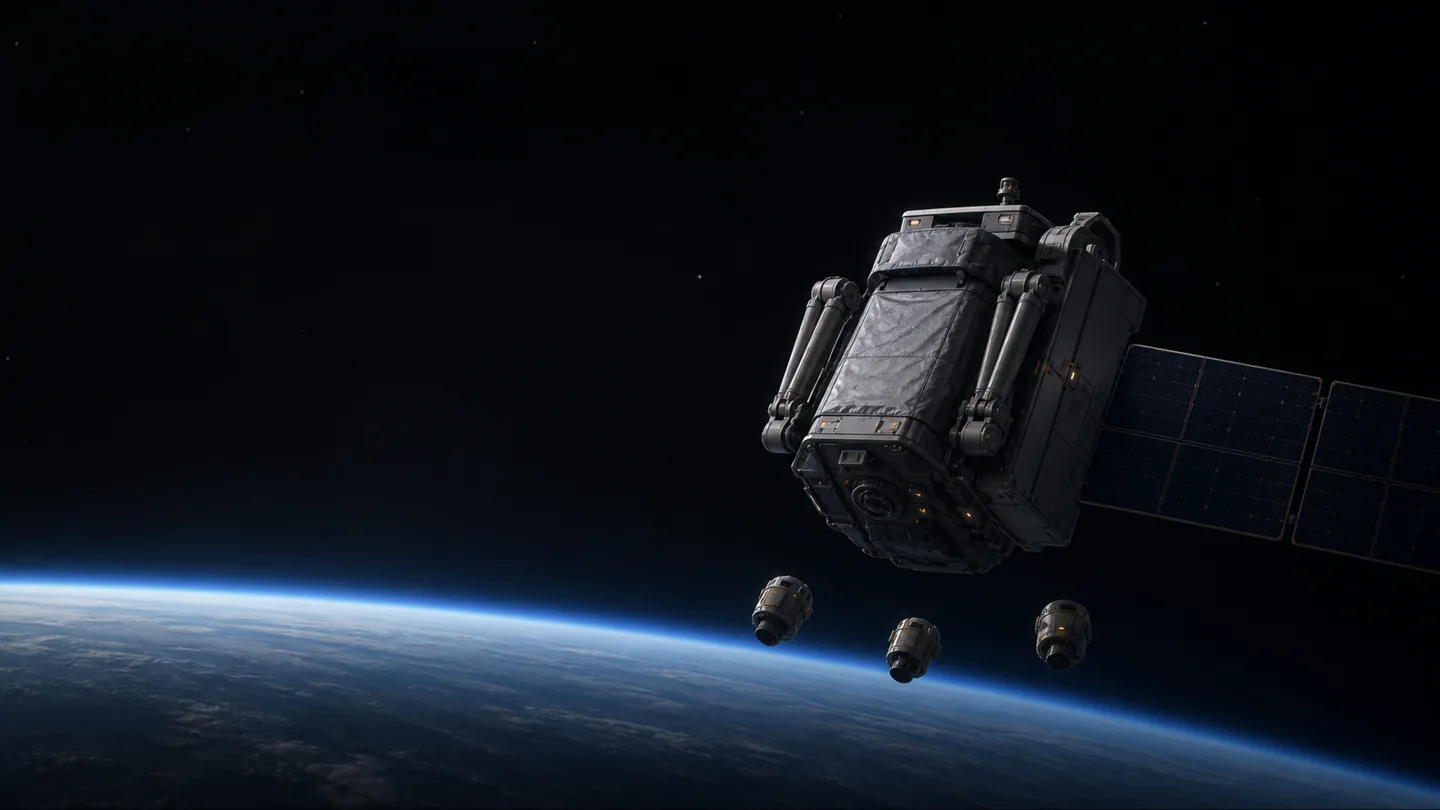
The Robotic Servicing of Geosynchronous Satellites (RSGS) payload launched at about 5:15 p.m. on July 21 from Cape Canaveral aboard SpaceLogistics’ Mission Robotic Vehicle, a Northrop Grumman company. The U.S. Naval Research Laboratory says the privately owned vehicle carries two robotic arms, and Via Satellite reports that three Mission Extension Pods were deployed after launch. That is a real change in program state: the servicing hardware is now in orbit rather than only in ground qualification or mission planning.[1,3]
It is not, however, a completed satellite-service job. The official record says the vehicle will take roughly a year to reach geosynchronous orbit before it begins proximity demonstrations. The Associated Press reports that SpaceLogistics plans its first servicing work for mid-2027, potentially involving SES and Optus satellites. No opened source reports a successful rendezvous, capture, refueling, repair or customer outcome.[1,2,3]
The operating mechanism is a staged commercial path. DARPA funded the program and the Naval Research Laboratory designed and developed the robotic payload; Northrop Grumman’s SpaceLogistics is carrying the system toward an operational service; and the Mission Extension Pods are intended to extend the lives of out-of-fuel communications satellites. The launch therefore exposes satellite operators, geostationary infrastructure owners and future in-orbit servicing suppliers to a new capability, but it does not yet establish service price, repeatability, proximity-operation autonomy or unit economics.[1,2]
Decision delta: consensus treated satellite servicing as a future capability backed by demonstrations and planned missions; this launch moves the program into orbital deployment while leaving the service claim unproven. Briefing-worthiness: 4/5. The next checkpoint is a dated proximity demonstration and installation or servicing event on a named client satellite in 2027, supported by telemetry, intervention results and a disclosed contract or price. Until that evidence arrives, the accurate headline is launch achieved, servicing pending.[1,2,3]