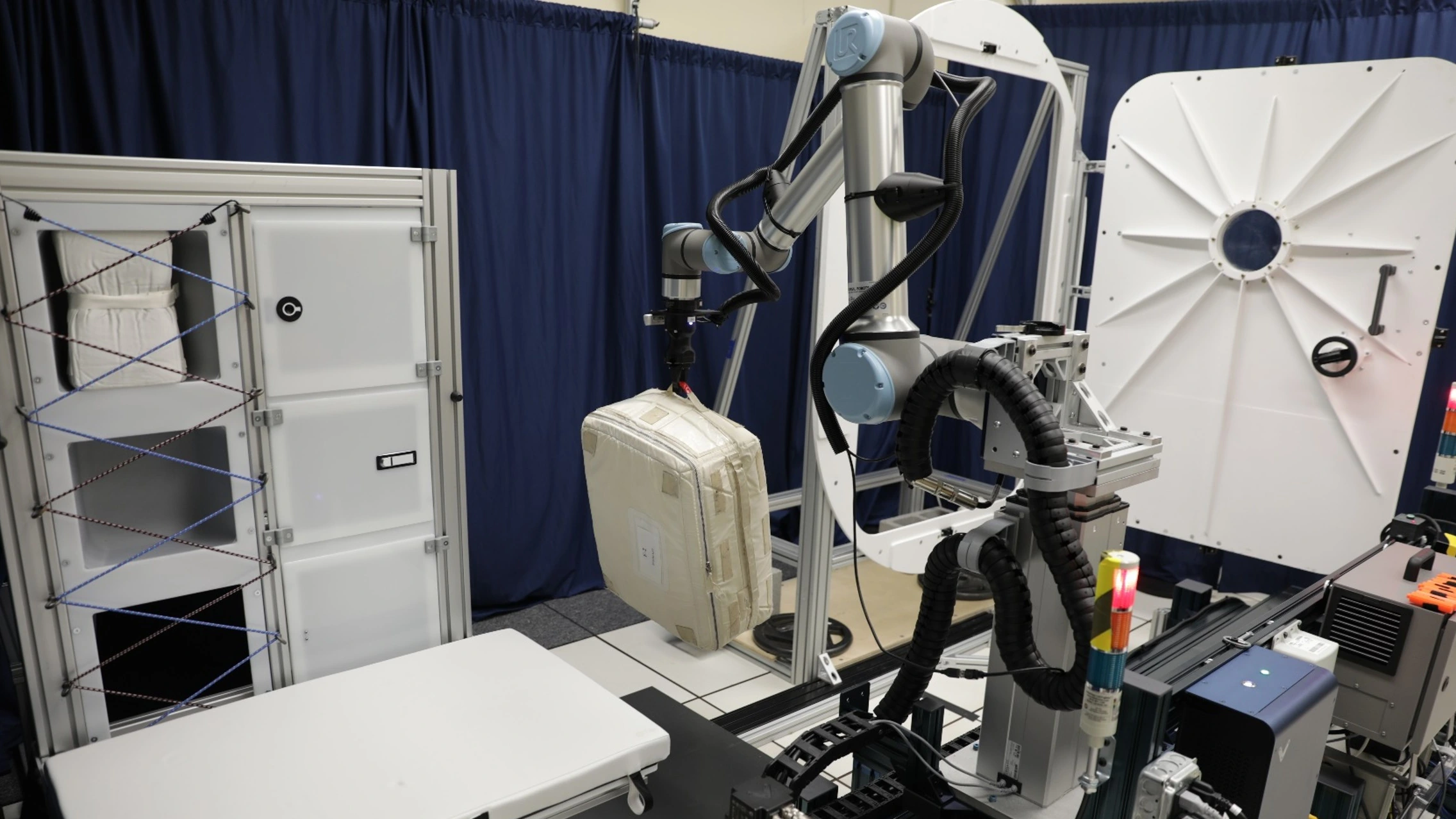
Google Public Sector has reported an initial 85% success rate for a robot locating and moving a medical bag in early laboratory tests at NASA’s Johnson Space Center. Its October 27 account describes a proof of concept using the Pi0 vision-language-action model, which connects instructions and visual input to robot movements. The result adds a task-level number to a programme previously described largely through its facilities and demonstrations.[1,3]
The useful boundary is the task being counted. Moving a bag is a logistics experiment, not evidence of autonomous diagnosis, ultrasound operation or a robot qualified for a lunar mission. Google describes retrieving and preparing an ultrasound machine as a possible assistance scenario; broader voice-directed tasks remain an ambition. Human medical judgement stays central to its proposed system.[1]
The account combines a camera positioned outside the robot’s hand with simulation in MuJoCo, a physics engine, before hardware work. It also reports fine-tuning a four-billion-parameter model in 2.5 hours on Google Cloud G4 computing instances. That is a training result, not a disclosed local inference speed, energy budget or end-to-end task time.[1]
Google says fine-tuned models can operate locally and that the team evaluated about 15 edge-computing devices over two years. This matters because spacecraft cannot depend on continuous Earth data-centre access. But the announcement does not identify a selected flight device or provide matched power, latency and task-success measurements for it.[1]
NASA’s separate account of its Integrated Mobile Evaluation Testbed for Robotics Operations, or iMETRO, explains why the setting matters. Physical mockups, simulation and robots let developers test logistics and maintenance around human-designed spacecraft interfaces. That context supports a laboratory integration story; it does not independently replicate Google’s percentage. Nextgov/FCW also obtained a NASA statement describing ongoing assessment of potential applications.[2,3]
The next useful evidence is a trial ledger: attempts, successful completions, interventions and recovery time, with the camera, hardware and local-computing configuration specified. Without the trial count, 85% alone cannot establish statistical precision or dependable crew-time savings. The advance is a reported manipulation baseline; operational reliability remains the next test.[1,2]