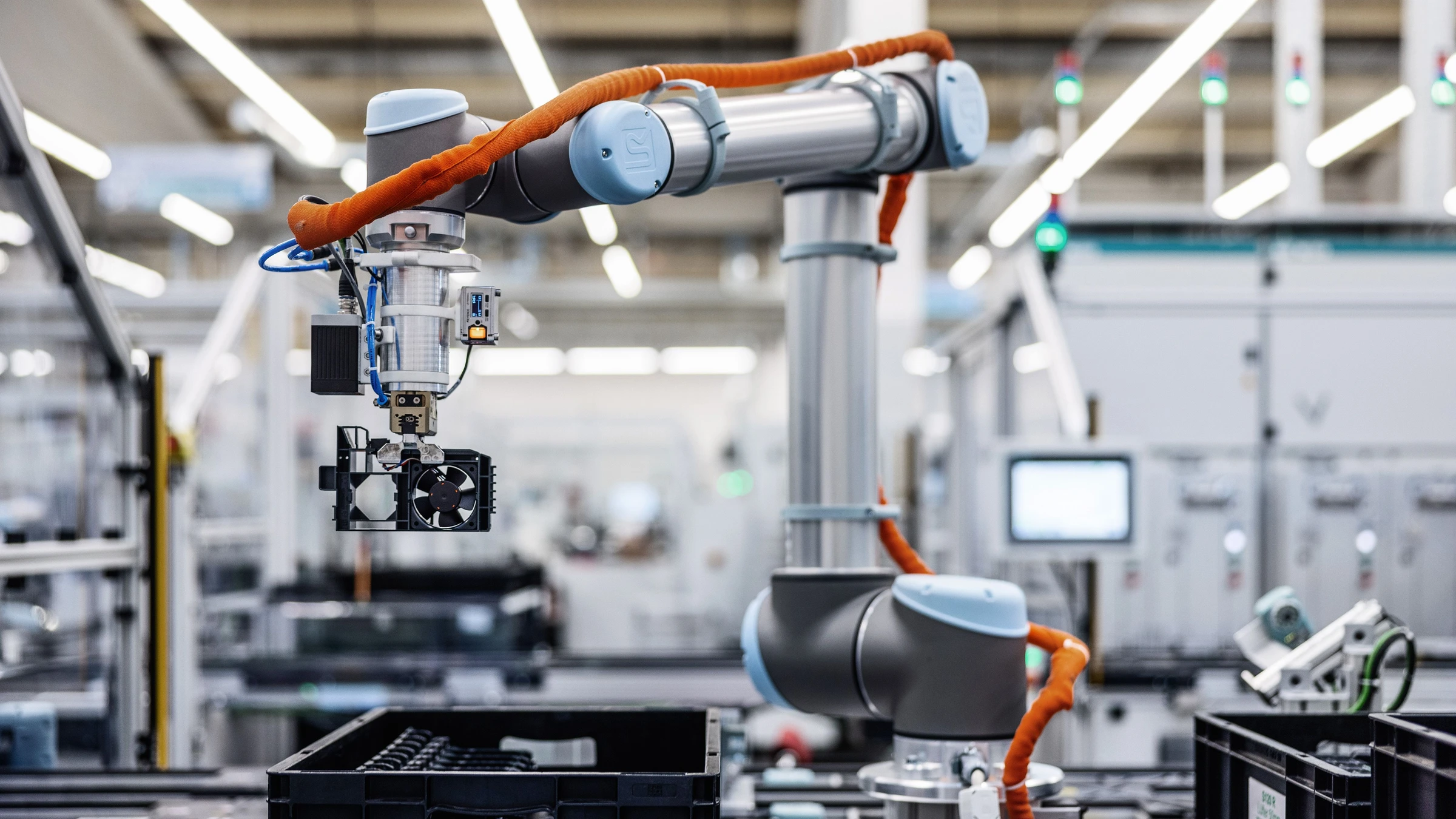
Siemens says it and NVIDIA are testing new AI inspection and production-planning applications in live manufacturing at its Erlangen electronics factory in Germany. The 19 October disclosure identifies two practical uses: preparing inspection before physical prototypes exist, and helping human planners compare production options.[1]
The companies announced their expanded manufacturing partnership in January 2026. Siemens’ current partnership timeline describes subsequent co-development and live-production testing at Erlangen, with the site serving as a route toward broader industrial deployment.[3]
What changes on the factory floor
For printed circuit-board assemblies used in drives and frequency converters, Siemens reports that virtual production preparation can reduce engineering effort by up to 85% and time to market by up to 40%. The workflow generates simulated images from digital models of the boards to train visual inspection systems before physical prototypes become available.[1]
NVIDIA’s published technical workflow separately documents generating clean and defective circuit-board images from design data, then aligning with real photographs. It illustrates how simulated data can prepare inspection models; it does not establish that Siemens uses that exact implementation or independently verify its savings.[4]
A separate planning agent generates options when new orders arrive, showing human planners how choices affect production. Proposed plans are checked in a digital twin, a simulation of the factory, before implementation. Siemens says this approach can enable cost savings of up to 20%. These are company-reported potential gains, not an independently audited result for every production line.[1]
The wider automation goal remains ahead
Reuters, reporting from Erlangen on 19 October, attributed to Siemens managing-board member Cedrik Neike an ambition to raise factory-manufacturing automation from 30–40% to 70–80%. That is a future target. It does not establish that today’s inspection and planning applications have already achieved that level.[2]
The distinction matters for manufacturers evaluating industrial AI. Faster inspection preparation addresses the work required to introduce a product; planning assistance addresses how an existing factory responds to changing orders. Each can be useful without demonstrating that the entire factory runs autonomously.[1,2,3]
The next useful comparison is between matched production tasks: time to prepare inspection, cost to revise a schedule, and the human interventions needed when products or materials change. Those measures would show how much of the reported benefit transfers beyond the initial applications. The reviewed announcements do not provide that common comparison.[1,3]