NVIDIA used GTC Berlin to expand the software and hardware available to robotics developers. Its 21 October announcement combines Isaac Lab 3.0, a new Isaac OS runtime and an Agile Robots reference humanoid. The practical aim is to connect data collection, simulation, training and deployment with less integration work between separate tools.[1]
The strongest distinction is between tools developers can evaluate now and hardware that remains on a release schedule. NVIDIA says Isaac Lab 3.0 is generally available. Agile Robots separately schedules its Agile ONE SN research platform for the beginning of 2027. Announcing an integrated development system does not establish that a general-purpose robot is ready for routine customer work.[1,2]
Agile ONE SN combines a compact humanoid with NVIDIA Jetson Thor onboard computing and preconfigured Isaac GR00T software. Agile Robots describes an open, modular workflow spanning demonstration capture, simulation, training, evaluation and real-world testing. It is aimed at researchers and developers; it is exploring safety-platform integration.[2]
The data pipeline is another part of the Berlin announcement. NVIDIA expanded Cosmos Data Factory blueprints for tasks including defect-image generation and video augmentation. It says ANYbotics generated more than 1,500 synthetic video clips to help train inspection robots to recognize spills and other facility changes. That is a reported training-data example, not an independently measured improvement in inspection reliability.[3]
Partner disclosures give the event a more specific industrial setting. Deutsche Telekom describes ELARA, a project involving Currenta, Wandelbots and T-Systems, as an initial virtual laboratory-automation prototype. The partners have replicated laboratory workflows and assessed economic viability. Transfer to physical robots is a later possibility, rather than a completed laboratory deployment.[4]
Reply’s GTC presentation uses a warehouse digital twin developed with Otto Group and NVIDIA. It reproduces different robot systems, their movements and their interactions, allowing proposed robots, layouts and processes to be tested before introduction into the warehouse. Reply presents this as a basis for coordinating fleets; its event announcement supplies no quantified operational improvement.[5]
Taken together, these examples point to a concrete buying and engineering question: how much setup, testing and integration can a shared development stack remove? The answer will depend on the task and site. A simulation result, a stage demonstration and a production outcome measure different things. Teams evaluating the announcements should keep those stages separate.[1,2,4,5]
The next useful evidence is accessible software with reproducible tests, followed by physical trials reporting task completion, human interventions, safety constraints and integration effort. For Agile ONE SN, shipment against the early-2027 schedule is a separate checkpoint. GTC Berlin advances the development toolkit; repeatable performance in real work remains the test.[1,2,4,5]
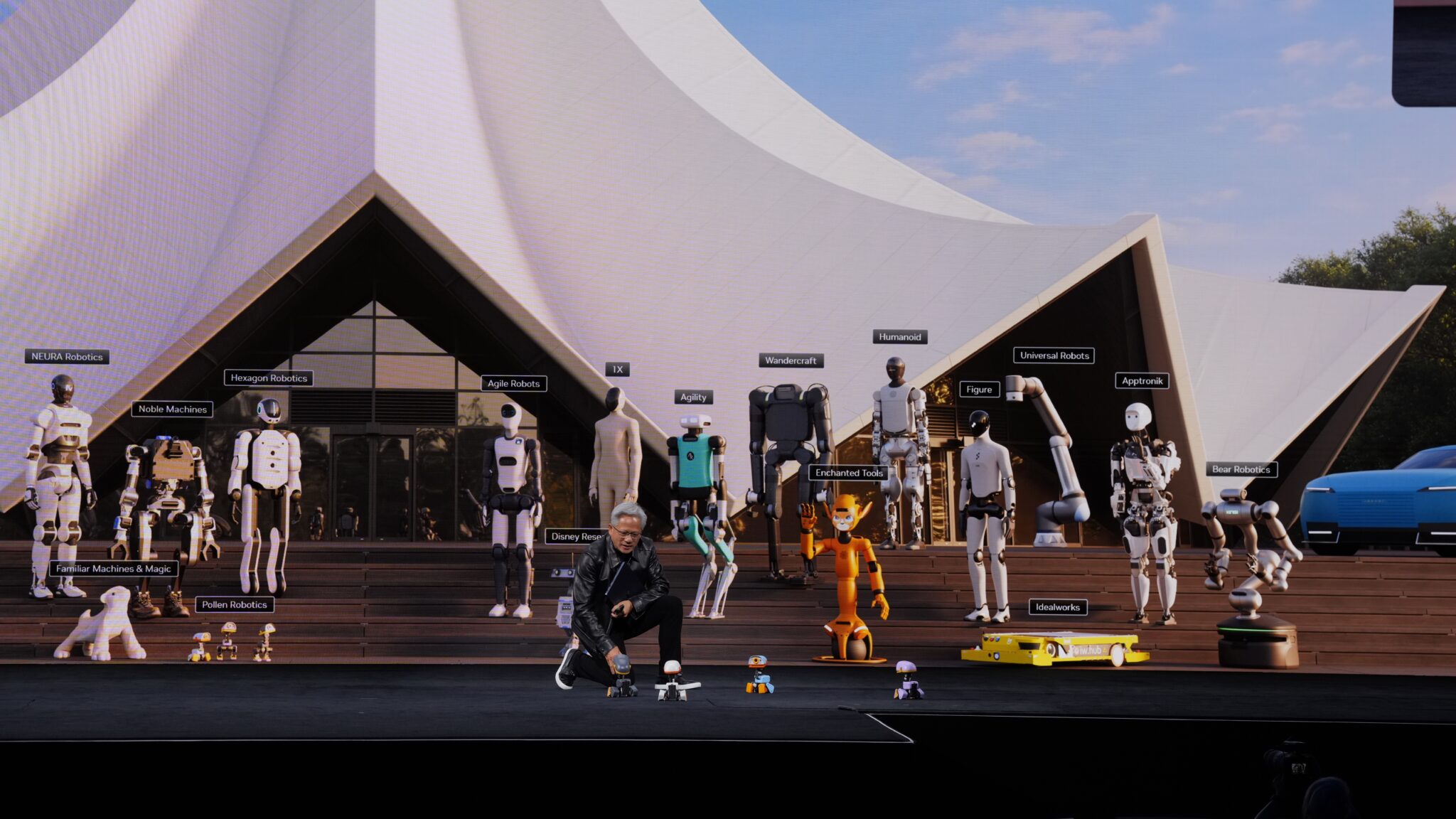
The cover shows Jensen Huang with four Microducks during the GTC Berlin keynote on 21 October 2026. The robots pictured behind him are on the stage screen; the photograph documents a demonstration, rather than a production deployment.[6]