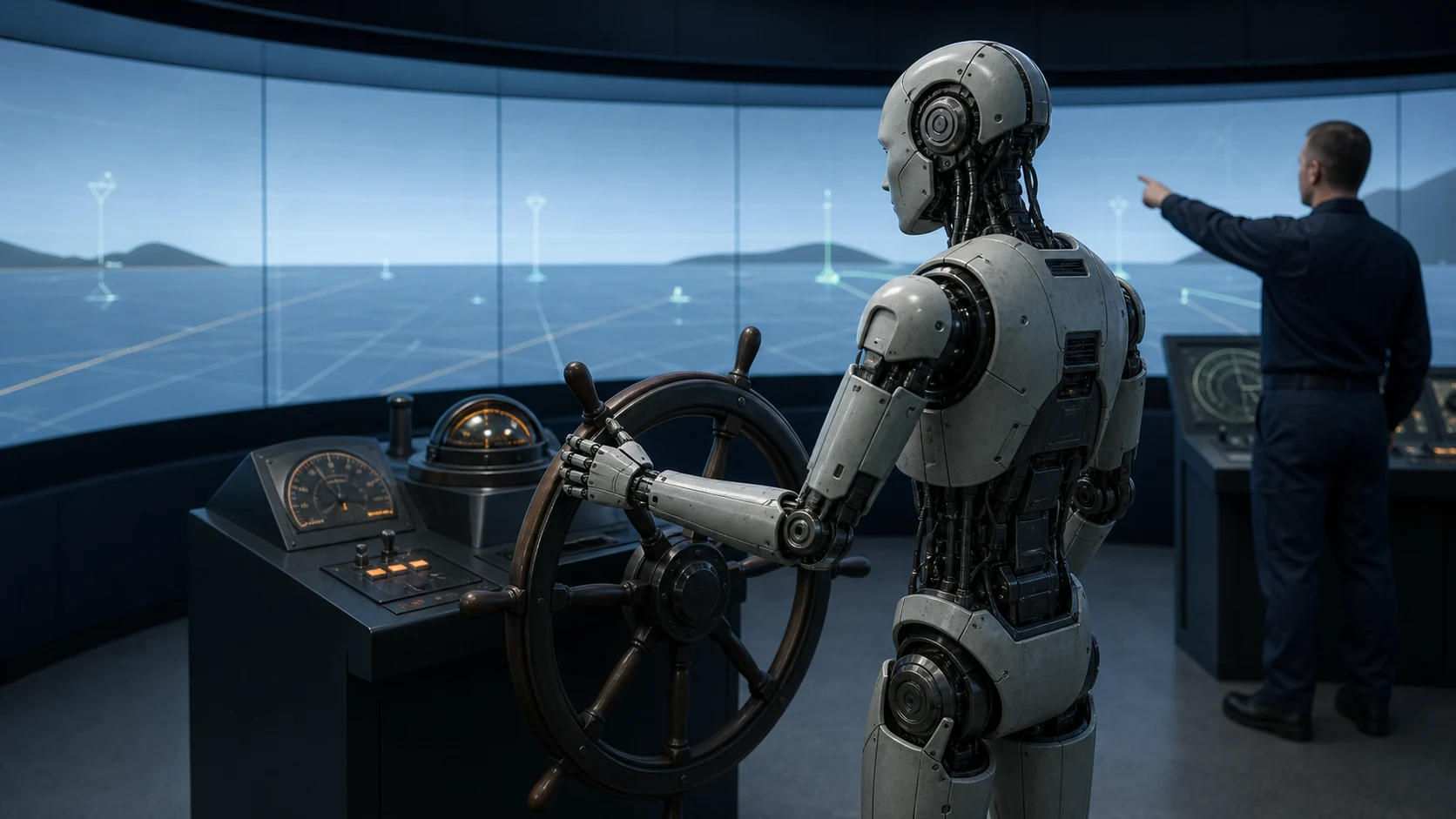
A simulator becomes a Navy test
The Republic of Korea Navy conducted its first combat experiment with a humanoid robot on July 23 at its Naval Education and Training Command ship-handling facility in Changwon, according to Yonhap, Korea Times and Aju Press. KAIST's Pibot took the helmsman's position in a bridge simulator and executed steering orders under an officer's direction. The opened reports describe simulated narrow-water, rough-weather and nighttime scenarios. This is a land-based test: they do not describe an active ship or an open-water trial.[1,2,3]
What changed is the institutional setting. Pibot was previously a KAIST defense-funded research project built around a humanoid operating aircraft controls. The Navy now says it will use the exercise to identify shipboard tasks that robots could perform and reduce sailor workload as manpower shrinks. KAIST's official record says the work has also been extended toward ships; the program received approximately 5.7 billion won in Defense Acquisition Program Administration funding.[1,4]
The decision is task fit, not robot replacement
That shifts the near-term question from whether a humanoid can manipulate a control interface to whether a Navy can qualify one inside a crewed system. The mechanism is compatibility with existing helm controls and human command procedures, not replacement of a vessel's navigation chain. The exposed parties are the Navy, KAIST, sailors, defense procurers and future integrators. The development is relevant because a task-fit result can change which crew duties are candidates for robotics even before a ship is unmanned.[1,2,3,4]
The strongest limit is that no source gives steering error rates, intervention counts, communications-failure data, a safety case, procurement decision or sea-trial result. The Navy's next measurable checkpoint is the reported progression from land simulator to a docked-vessel test, then daytime and day-and-night sea trials. Until those stages produce comparable logs, this is an institutional test of task fit, not fielded autonomy.[1,2,3,4]