What changed
A Xiaomi Robotics team has posted ViTacPhys, an under-review preprint that predicts mass, stiffness and friction from human visual-tactile demonstrations, then passes those estimates into a dexterous-hand grasping policy. The authors report 83.4% total grasp success on their out-of-distribution set and a 38.9-percentage-point clean-success advantage over Action Chunking with Transformers, or ACT, on that set.[1,3]
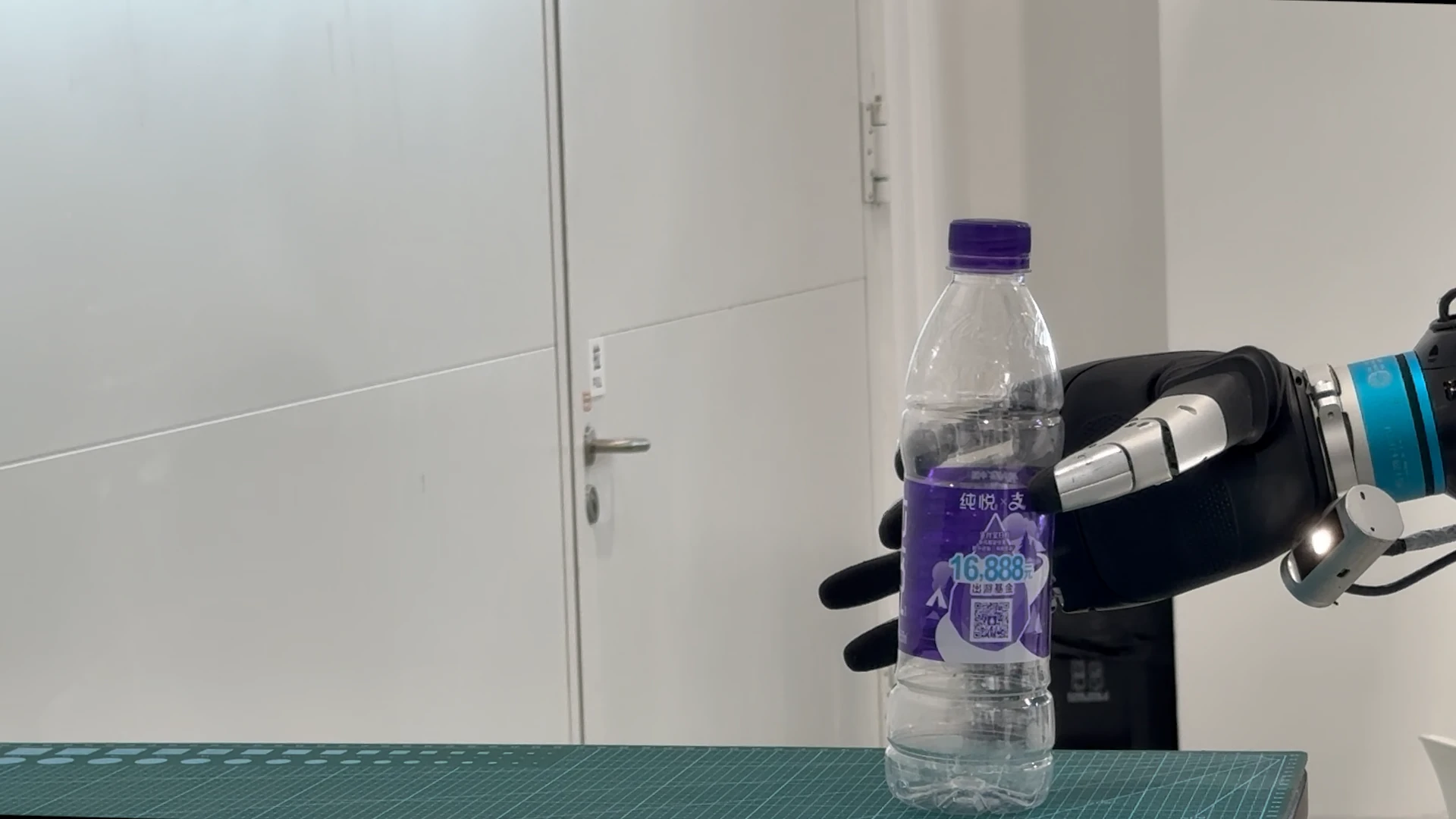
That is a useful direction for handling objects that look alike but differ in weight, stiffness or slipperiness. But the mechanism is narrow: the system first estimates three properties from a wrist camera and fingertip pressure maps, then conditions an ACT-style policy on those estimates. It is a physical-grasping feasibility result, not evidence that a general robot can infer every relevant object property.[1,3]
The denominator matters
The most consequential limit is the final test size. The paper defines six visually similar out-of-distribution pairs: 12 objects, each evaluated three times for each method. That makes 36 real-robot attempts for the reported policy, not a broad field trial. The human dataset is also 1,800 one-second demonstrations from 60 objects, collected by one participant; the authors explicitly describe the work as a feasibility study. That does not erase the result, but it makes the result a narrow test of whether explicit property estimates help in this particular grasping setup.[1,2]
The properties themselves need similar care. The tactile maps primarily measure normal pressure, so the work puts mass and the friction coefficient into low, medium and high classes. Its stiffness figure is a grasp-level measurement that includes deformation in the object, the sensor mount and the contact system; it is not a universal material constant. Those choices are sensible for a controlled adaptive-grasping experiment, but they make the reported accuracy unsuitable as a direct specification for a warehouse, home or factory robot handling a wider object mix.[1]
Reproducibility is the next real test. The project page lists both code and dataset as coming soon, while the paper says future work should add participants, objects, broader out-of-distribution trials and faster semantic priors. A public artifact release and an independent, cross-hardware test would show whether the reported improvement comes from property-aware control rather than this particular sensor layout, object set and teleoperated setup.[1,2]